Friday, 10 February 2012

LaRM day 22 (Azure Ray-Bachman Turner Overdrive)

And the A journey finally ends with the third album by Azure Ray which is called Hold On Love (2003). This is a great record, a real under the radar number, which didn't really grab anybody's attention which is a shame. It's a successful version of sort of thing that Tegan & Sara try to do with relatively little success, a sort of gloomy spirited but musically engaging femininity. In indie-rock terms, it's a bit more ambitious, a bit smarter, and a bit more dour than most (and certainly than most white-boy indie-rock). It's very muted, it's the aural equivalent of looking through gauze, and it's clearly pretty heartfelt stuff. There are a couple of off moments, but tunes like 'The Drinks We Drank Last Night' and 'These White Lights Will Bend to Make Blue' are so fabulous, they easily make up for any longueurs.

B! At last. Now, as A took a month, I estimate that B should take us seven weeks. Let's see. We kick off with Katy B's On a Mission (2011). I should hate this record. Everything about it is wrong. It's cheap pretend dubstep, sung by a Brits School graduate who looks like Joss Stone. And yet, and yet... what is about this record I wonder? I really, really like it. What can I say, maybe I've just fallen for the hype like every other Guardian reading middle-aged idiot (and as a Guardian reading middle-aged idiot I do find it hard to not fall for certain stuff). If this were marketed differently, or if it wasn't the "dubstep it's easy to like" then maybe I'd hate it, but I don't, I like it a lot. Then again I don't hate pop music on the whole, so maybe it's not so surprising. Anyway, it's alright.

AAARGH, let's shout along to Babes in Toyland and their first album Spanking Machine (1990). I absolutely adored this album back in the day, adored it. It was one the key records that defined my taste at the time, and I really felt that it represented the best of one aspect of the US indie underground. It involves some rather, er, primitive drumming and wholly uninspired bass but the jagged guitar and screaming and shouting of Kat Bjelland really gave it some serious personality. It's claggy, thick stuff and listening to it now feels more difficult than it did back then but it's still an impressive and deeply individual record. In many ways it's a shame that Hole formed after Bjelland kicked Courtney Love out of Babes in Toyland because Hole sounded very similar, but much, much less interesting. 'Fork Down Throat', 'Vomit Heart', 'Dogg', really all the songs are great too. The follow-up mini-album To Mother (1991) is more of the same but is a rather more mixed bag. The better songs are the best they ever recorded ('Catatonic', 'Laugh My Head Off') but the duds are terrible ('Primus', 'Spit to See the Shine') and you can hear that they could take a wrong turn which in my view they did (partly because of the success of grunge affording any bands defined as "grunge" the luxury of higher budgets, which for the most part killed the creativity of the majority of those bands).

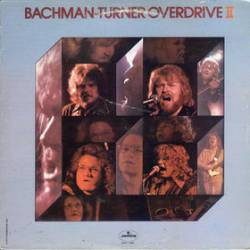
Right, next would be the first six albums by Babybird which came in a box-set for £3. There are a handful of decent tunes buried in this lot, but there's always seemed to me to be something very wrong about Babybird but I've never been able to put my finger on what it is. It all feels sort of nasty, cheap, like the records should smell slightly mouldy or something. Anyway, because I never put them on my ipod the only way to listen to this at work is one song at a time on Youtube and there's no way I'm doing that so we have to skip straight on to the mighty (arise Sir) Bachman Turner OBEverdrive and their second album, the imaginatively titled Bachman Turner Overdrive II (1973). Let there be Canadian 70's rock. We all know 'You Ain't Seen Nothin' Yet' from the first album and of course everything they did is pretty much a variation on that (although II's marimba rock shuffle 'Welcome Home' is a surprise) and if you like to rock in a classic stylee you can never go wrong with the BTO.

That's it for now. I'm on holiday so this mutha will be back up and running next Thursday. Laters!

Thursday, 9 February 2012

LaRM day 21 (David Axelrod-Aztec Camera)

Yikes, let's get all freaked out with 60's uber-producer David Axelrod's own albums. First up it's 1969's Songs of Experience (I haven't got the accompanying Songs of Innocence). Now, I'm not convinced that Blake had funked up basslines and hippy flutes when he was knocking his poetry together, but more fool him if he hadn't because Songs of Experience is awesome. It alternately floats, drifts, bubbles and churns, it's the soundtrack to a kind of pretend version of the 60's that everybody under 40 imagines the 60's were like, which is amazing for a record that was made in the real 60's. It's simultaneously a Beverley Hills fantasy and a ghetto nightmare, it's cheesy, silly and brilliant. 1970's Earth Rot is a slightly more tricky affair - it retains the basic ingredients, but it's all more muted (environmental catastrophe isn't really an upbeat funky bass kind of subject I suppose), and there are some horrible massed voices chanting in a mind-bogglingly cheesily 60's way about what we're doing to the Earth, man. On the whole though Axelrod was still pushing the envelope, throwing in some freeform sax breaks in amongst the downbeat funk and plainsong.

Axelrod's fantastical funk is followed up by the first of our occasional forays into the world of J-Pop with the eponymous debut album by cutesy actress Aya Ueto (2003). J-Pop is, of course, by definition extremely corny and Aya Ueto is at the corniest end of the J-Pop corn spectrum. In fact the cornometer can barely measure this album. It's got some great moments, but it does veer a little close to a Stock Aitken and Waterman style of production on occasion. There are some massive pop songs, that's how this stuff works, but Ueto is no Hikki or Ayu and it's relatively bland stuff compared to those giants of the genre. She's great in the Azumi movies though.

We would then move on to Azita's Enantiadromia (2003) which is a strange post-rockish sort of thing with half of Tortoise playing on it, but it's a vinyl only-no internet job, so we have to move straight on to an Aztec Camera marathon. Now, this may seem a bit strange that I've got a bunhc of Aztec Camera records, but these date from the time when we were getting loads of records at work so I used to pick up all kinds of stuff and that explains quite a lot of what's to come as we travel through the alphabet (five Harry Chapin albums? I mean, really, what was I thinking?). So anyway, High Land Hard Rain (1983) was notoriously written and recorded by Roddy Frame when he was only four years old. Incredible to think that a pre-teen was that adept at jazz chops and formal song structure. He wasn't, he was about seventeen, but there's something vaguely unnerving about a teenager at the turn of the 70's wanting to write jazz inflected pop-rock songs rather then being in a punk band or Bauhaus or something, but there we are. It's a really fine record, uncomfortably competent for a child, but still ragged enough around the edges to be charming, and while the songwriting is mature, the lyrics are still pleasingly naive. Second album Knife (1984) was disastrously produced by Mark Knopfler and the charming edge of High Land, Hard Rain is effectively knocked clean off, leaving simply a "mature" singer-songwriter's album with some horrible keyboards on it which sounds awful and has a serious paucity of decent songs, as Frame seemed to be trying way too hard to write big, serious tunes. It's not actually a totally terrible album ('Still on Fire' is a nice tune) but the R&B influence doesn't sit at all well with Frame's weedy Scottish musical character and it's easy to see why the album got so roundly eviscerated at the time.

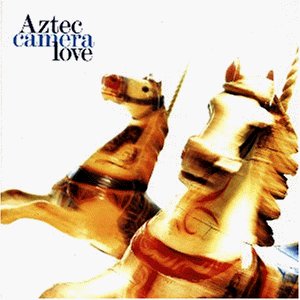
After a three year break and the sacking of every other member of the band, Frame came up with the begging letter to the US charts that is Love (1987). This is a seriously insipid piece of half-baked pop music that really doesn't give much cause for hope that he would ever recover the charm of High Land, Hard Rain. It does have chart smash 'Somewhere in My Heart' on it though, and I can't deny that's a great pop song. With the blank indifference of the US clearly smarting, there wasn't another Aztec Camera album for a further three years, and when Stray (1990) was released it was clear that the US breaking ambition had been reined in, and a refocussing really worked wonders. Stray has some great songs, not least the apparently written-in-three-minutes 'Good Morning, Britain'. 'The Crying Scene', 'Notting Hill Blues', there are some great songs here, and all of them back on strictly parochial ground. The rather forced R&B stuff has bitten the bullet and we're back to the much more comfortable jazz-tinged songwriting which works much better.

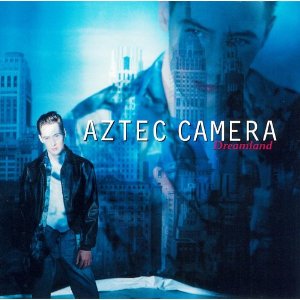
Another three years and another album with 1993's Dreamland. This is almost exactly the kind of record Roddy Frame was always destined to make as he got older. It's polite, graceful, solidly written, nicely produced and entirely inoffensive. It's a delicate record, and one that announces itself in stately fashion with no pretence to anything as radical as innovation or challenge. There's absolutely nothing wrong with it except the fact that it has absolutely nothing of particular interest to say, it's just a perfectly nice early middle-age kind of record. And finally for the Camera, and for the day, it's Frame's last go under the Aztec Camera moniker before accepting that it was almost always a one-man band, Frestonia (1995). This is unsurprisingly more of the same kind of stuff as Dreamland, and I repeat absolutely word for word what I said about that album in relation to this one.

And tomorrow we finally come to the end of the A-road and branch out into the wilder (and considerably lengthier) pastures of the letter B. Let's have a wonderful evening, ready for a whole new alphabetical adventure.

Wednesday, 8 February 2012

LaRM day 20 (At the Drive-In-Avett Brothers)

So, after that little hiatus let's continue with At the Drive-In and their big one, Relationship of Command (2000). This where it all gets more serious and certainly more grandstanding. If anything the absurd angst of the vocals and lyrics combined with a kind of bombastic post-punk arrangement makes me think of a cross between the Manics and U2. Weirdly I really enjoy Relationship of Command but unlike the rest of the world, I think it's basically rubbish. Fun rubbish but rubbish nonetheless. It's like a page from a teenage loner's diary: intense, serious and utterly laughable. After that we've got 2005 compilation This Station is Non-Operational. Most of it is culled from the records we've already gone through but there are a couple of alright tunes from Vaya and some odds and ends, most of which are unnecessary (a dismal prog-punk version of Floyd's 'Take Up Thy Stethoscope and Walk' anybody? No thanks. A shocking cover of 'This Night Has Opened My Eyes'? Hmm, no, I'm alright ta.) and don't add much to what we already know.

Now it's Moo You Bloody Choir (2007) by Augie March. Terrible band name, terrible album name, but they're apparently pretty popular in their native Australia. It's a decent, pleasant and thoughtful rock record. It's fairly instantly forgettable though, so it's one that will be going on the reject pile. That is after all part of the purpose of doing this stupid listening to everything exercise, I've got to get rid of stuff before the floors collapse at home.

But now we get the afternoon started off right with the lovely Au Revoir Simone, starting with debut mini-LP Verses of Comfort, Assurance and Salvation (2005). They're a lovely outfit are Au Revoir Simone. The wheezing and slurring of their vintage keyboards provide a choice backing for the laid-back, emotionally neutral vocals. Their records are restrained affairs in every sense. They're gentle and unchallenging, but there's always the sense of great turmoil underneath the placid exterior, as if not expressing is all about the desperate need to not express. If you see what I mean. Anyway, Verses is the least successful of their three records, only because it's rather uneven in tone, one minute being mournful, the next popping about all over the place (all in politely restrained fashion of course), and on the whole the songs aren't particularly strong. It's still lovely stuff though. The Bird of Music (2007) is the best of the bunch. There are some fabulous pop songs here, and for an album so delicately undemonstrative it always comes as a surprise that some of the songs are weirdly moving. Lyrically there are some peculiar little phrases and any whimsicality is always undercut by a sense of something dark moving underneath the surface. Finally we have Still Night, Still Light (2010) which is, if anything, even more guarded in its approach to a listener and as a result is slightly colder than The Bird of Music and has a greater emphasis on the melancholic end of their style. It's not as immediately enjoyable a listen as a result but it is a fine record nonetheless. (PS I think the description of Au Revoir Simone as being Bananarama with librarians is not quite accurate...).

Let's get all ambient techno on our asses with the first album by Autechre which is called Incunabula (1993). Here's another example of what I was talking about before in relation to the Aphex Twin. I used to pretend I loved this stuff. In fact, listening to Incunabula now I'm struck by how much more I genuinely like it than I did back when I used to pretend to like it. If anything, it's improved with age, and despite still sounding like a 1990's piece of experimental ambient, it has a really nice feel to it, some genuine melodies, and the very low-key way in which it experiments with rhythm and, er, sonic texture means that it doesn't sound so obviously of its time in the way that much of this stuff does. In many ways it's to do with the very clinical and spacious feel of the record, there's no concession to clubbers really, it's pretty much all just bedroom headphone atmospherics, and it still works really well.

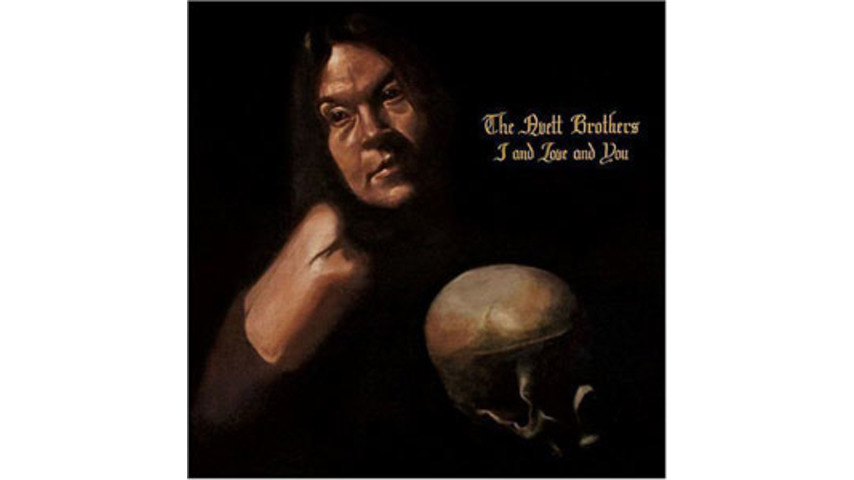
And finally for today it's another one that's going on the reject pile, I And Love And You (2009) by the Avett Brothers. This is another one of those folksy, Americana-y, way too serious-y records which you only half concentrate on and think sounds really good, rootsy, good tunes, but when you give it your full attention you realise is really only half a record. One of those v. good, but could try harder type of efforts. When space in your tiny flat is at a premium, it's cheerio to the Avett Brothers.

We might finish A tomorrow. How about that then boys and girls?

Friday, 3 February 2012

LaRM day 19 (Asobi Seksu-At the Drive-In)

Today began with the first two albums by US retrograders Asobi Seksu. The self-titled first album originally released in 2002 is a solid indie rock album, with an obvious debt to shoegazers of yore. In fact it sounds like My Bloody Valentine with a female singer. The interesting thing about Asobi Seksu is the feeling that they don't take themselves too seriously and the fact that half of the songs are in Japanese is proof that they aren't too concerned with audience response. Of the many, many MBV tribute acts in the world Asobi Seksu are a really good one. The first album is pretty consistent, but the songs are fairly forgettable. As is often the way, second album Citrus (2006) is a marked step forward, with a cleaner sound and a clearer sense of purpose (that purpose being to sound even more like Chapterhouse than ever). There are even traces of the unfairly maligned Slowdive in here, and most importantly there are some lovely songs.

And so we move on to something about which I am apt to eulogise - Virginia Astley's From Gardens Where We Feel Secure (1983). This is quite simply the most beautiful record ever made, and sits easily in my top ten of all time. It's a completely unique, idosyncratic, utterly fabulous creation. An instrumental work played on piano with occasional woodwind backing and field recordings of birdsong and church bells, it charts the simple pleasures of idling in the English countryside on a single summer day, from dewy morning to balmy evening. This obviously makes the whole thing sound insufferably twee but it isn't, it's absolutely breathtakingly lovely. If you close your eyes, you're actually there, laying back in a lush field with the sun beating down on your face, or struggling to sleep because of the heat of the evening. If there is a crticism that could be made it is that the record is so painfully middle-class, it absolutely reeks of the privileged position of living in the countryside and having the luxury to laze about. For myself that criticism doesn't wash though, because frankly my fantasy is to be in precisely that privileged position. There's almost nothing more I can say about this record because it's all summed up by simply saying that it's the most romantic, lush, moving, joyful, wonderful collection of pieces of music outside of the classical music world.

And so from the sublime to the absolutely ridiculous, it's Germany's Atari Teenage Riot. Let's start the riot with Delete Yourself from 1994. In amongst the surprisingly unthreatening pummelling drum machines, jagged keyboard noise, occasional metal guitar figures and priceless TV samples, Alec Empire, Carl Crack and Hanin Elias telling us things like "life is like a video game with no chance to win", and "maybe we'll sit down and talk about the revolution and stuff" and shouting completely meaningless slogans are some genuinely great tunes. It's difficult to concentrate on trying to find them though because you're laughing so much at just how tragically earnest all this nonsense is. Delete Yourself is a sort of pre-gabba attempt at bringing politics and metal to the hardcore dancefloor and while it fails dismally it does succeed instead at being an endearingly loopy bunch of lo-fi hardcore electronica. Second album, The Future of War (1997) is more of the same but amped up even more, and to be fair, it does succeed in sounding less weedy than Delete Yourself. It still all has the feeling of being physically threatened by a puppy though. It thinks it's the hardest thing in the world and, well, it isn't. Again, there are some fantastic songs on here ('Destroy 2,000 Years of Culture', 'Sick to Death') and if you can get past the hurdle of how silly it all is, it's a great listen.

We'll skip over Burn, Berlin, Burn (1997) because it's just a compilation of tracks from the first two albums released for the US market. ATR upped the ante in every respect even further for third album 60 Second Wipeout (1999). For the first time there are live thrash metal guitars rather than samples, the drum machine poundings are harder than ever and the shouting and screeching even more pronounced. It's a fantastic record, there are some brilliant songs and the sheer unadulterated absurdity of the whole thing is beyond compare. It's brutal noise but thanks to the daftness of it all, it's still completely unthreatening. It's fantastic. Finally for ATR we have the Live at Brixton Academy album from 2000. This was a recording of a live show in 1999 which is literally almost half an hour of scraping, screaming industrial noise. There are no pretences to tunes, it's simply constant horrible noise. I can't possibly do it the justice that is done by the NME review (which scored it 11 out of 10) on its release and which is easily as nonsensical, idiotic and hilarious as ATR's records and most of which I therefore copy wholesale for your enjoyment here:

"Just 27 minutes long and compressed into a single track, this is not so much a performance as an attempt to punch a gaping hole in the space-time continuum and rip its throbbing purple guts out with a giant sonic pitchfork. It's aggressive, abrasive, breathtakingly brutal and unlikely ever to be chosen on Desert Island Discs. Key to this ground-breaking dissonance is new-ish member Nic Endo, mistress of merciless machine torture. While Atari shows once used recognisable beats, samples and riffs - albeit revved to the limit of speedcore distortion - Endo seems to have pushed them over the edge into a black hole of pure inhuman noise. For the strong of stomach, we particularly recommend the cataclysmic electropunk ejaculations around three minutes 40, the sound of Satan himself sharpening his huge mechanical rotating knives at 13 minutes 45, the Panzer division of crazed Pokimons committing mass suicide at 24 minutes 10, and the blessed relief which dawns around 26 minutes 48 when you realise the storm has passed and that which has not killed you has left you, er, feeling violently sick. Any appreciation of this record, then, lies not in orthodox critical standards but in how extreme and masochistic your taste for sonic punishment is - or how murderously grim your sense of humour. If you have ever discerned apocalyptic beauty in Neil Young's 'Arc', nihilistic purity in Lou Reed's 'Metal Machine Music', cathartic splendour in prime time Napalm Death or blowtorch majesty in My Bloody Valentine's nuclear meltdown finale to their 1991 tour, then 'Live At Brixton Academy 1999' will rock what remains of your brain until it spurts out your ears. Respect."

Brilliant, no?

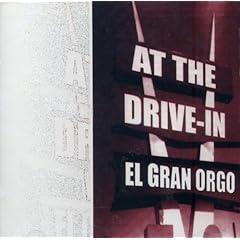
So having endured the excoriating whiteout of Live at Brixton Academy it's quite a relief to listen to the fairly straightforward punk-pop of At the Drive-In's mini-LP El Gran Orgo (1997). Amongst the three minute punk nuggets (and sly nods to other bands - the reference to the Cure on opener 'Give It a Name' is tricksy) there is little to suggest the punk-U2 that they were to become, or indeed the punk-prog that Omar Rodriguez-Lopez would end up specialising in. With the exception of 'Fahrenheit' these tunes would sit pretty neatly next to the Get Up Kids or Sunday's Best without anybody really raising an eyebrow. Second album In/Casino/Out isn't much different, but there are a few more funny time changes and structural mucking-about but again, not such as to give away what the next album would sound like, which will start the new week.

Do have wonderful weekends, won't you?

Thursday, 2 February 2012

LaRM day 18 (Ashtray Boy-A Small Good Thing)

Very brief today because of a company meeting going on all afternoon, so only time for a couple a rekkids, starting with Ashtray Boy's The Honeymoon Suite (1992). This is a great album, a kind of super lo-fi ragged pop, a la Beat Happening, but even more charmingly done. Off-beat tales of Shirley Maclaine's spiritual awakening, bakers finding love, and truckers on honeymoon, set to a spare, ramshackle indie soundtrack makes for a kind of cheerfully idiosyncratic Australian interpretation of Raymond Carver as pop music. It's over in half an hour and leaves me smiling every time. PS, it's worth mentioning that on a couple of songs the backing vocals are provided by a pre-fame and certainly pre-shit Liz Phair.

Then it's Slim Westerns (1994) and Slim Westerns Vol. II (2002) by A Small Good Thing (what a coincidence, Raymond Carver again - I assume A Small Good Thing are named after his short story). Should this come under A or S? Ah well, it's a moot point now because I'm doing it under A. I don't know anything about this outfit and only bought these records because I was buying everything that Leaf released, for reasons that now completely elude me. Anyway, it's worth discussing these two together because they're basically versions of almost exactly the same thing (Vol. II is perhaps a bit more obviously ambient oriented). If it's spooked-out Morricone rip-offs you're after, these will do the trick and no messing (funny one that "Morricone-esque" description because, of the 400-odd soundtracks Ennio has written, only a handful are for Westerns and sound remotely "Morricone-esque"). They're good records, all dust and flies, and incredibly atmospheric, but you really need to be in the mood for this stuff. The conceit is carried through to its fullest, with a "slim Western" being included as part of the package but to be honest who needs to read a badly written story about a cowboy called Gerry Melody? That's incidental to the music which is suitably arid and occasionally psyched-out to give it that added desert peyote trip feel, but the sign of the difficulty with this kind of record is that I can't help but feel that they must be English....
And that's it, sees you tomoz.

Wednesday, 1 February 2012

LaRM day 17 (Architecture in Helsinki-Ash)

Let's start with some eccentric knockabout pop fun with unpredictable Australians, Architecture in Helsinki's second album, In Case We Die (2005). It's a marvellous record is this, shallow as a really shallow puddle, but great fun, and you can't second guess anything that's coming, even after you've heard it loads of times. Although it's still essentially lo-fi indie rock, there's a sense of real ambition here which doesn't detract remotely from the enjoyment to be had from the whole thing and it's absolutely delightful. It's funny that this should follow so close on the heels of the Arcade Fire, because I think it's sort of what they might sound like if they had any sense of humour.

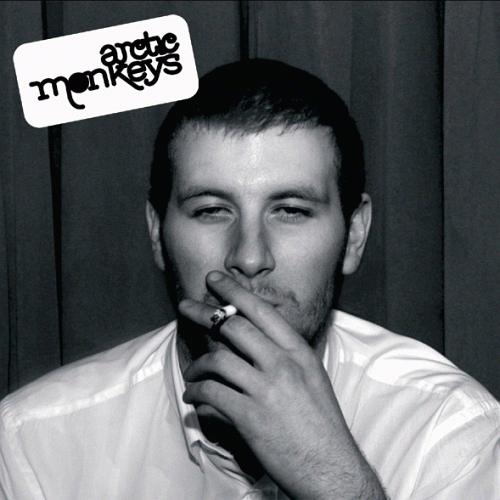
And so, on to a bit of an Arctic Monkeys jag. Is it not the worst band name? I mean really, it's one of the reasons why when Dawn Lewis kept going on at me about how brilliant 'I Bet You Look Good On the Dancefloor' was, I wouldn't believe her. Anyway, despite the fact that the aforementioned song is truly great, the single has one decent B-side and a pointless instrumental, so let's move on to the first album, Whatever People Say I Am, That's What I'm Not (2006). Well, everybody knows this one, it's a great record, but what really marks it out are the superb lyrics and phenomenal rhythm section. It's often pointed out that they have one of the finest rock drummers around and not for no reason, he's out of this world. In some ways, although Alex Turner's songs are really special, the life really comes out of the rhythm section and later on there's a high price to be paid for trying to restrain them for the sake of the songs. A brief mention of the Who the Fuck are the Arctic Monkeys EP (which is really the 'View from the Afternoon' single) which has a couple of great B-sides in 'Cigarette Smoker Fiona' and 'Despair in the Departure Lounge'.

Second album Favourite Worst Nightmare (2007) is the high point as far as I'm concerned. Superb album this, even when the songs are a bit obvious ('Brianstorm') and as a dissection of low-rent existence it makes Arab Strap's lyrics look like the most absurd juvenile nonsense. But the brilliance, lyrically, of Favourite Worst Nightmare is its comparison of real life to that of a now famous and successful band. Turner has no illusions about anything it seems, and the fact that one of his bandmates is going out with a topless model has no bearing on his own knowledge of the pitfalls, the tawdry pointlessness of fame and the illusion of contentment of the successful. It's fantastic stuff, tied to some bitingly vicious, and some painfully tender tunes. Many people find the album too obvious, but I think this is really something quite special, and again, what drumming... Then it's the come-down of third album Humbug (2009). Despite having a couple of really fabulous tunes ('Cornerstone' is lovely) the album feels like it was a weight to the band, a difficult and tiring process which means it has a strangely airless and flat feel to it, as if their own interest was waning. Indeed Turner was busy with other projects (passable Scott Walker impressions) and personal circumstances (hanging out in New York with Vogue botherer Alexa Chung - there's something - when did Vogue become an "advertorial" for people of the calibre of Alexa Chung? What happened to ethereal mysterious otherworldly models from all corners of the globe? It all seems to be children's TV presenters and second rate pop band members these days) and I think maybe the album was not a priority. In any event, it's the point at which I stopped paying any attention.

Now on to something altogether less vigorously male, and indeed much more delightful to listen to. It's the first album by part-time Múm member, Ólöf Arnalds called Við og Við (2007). This is super-special - beautiful little acoustic guitar or harp numbers and a stereotypically Scandinavian high, girlish voice. It's charm personified, a truly magical way to spend 40 minutes. Why haven't I bought the rest of her records?

Alright let's get multi-cultural for a change and dig some absolutely crazy tabla/electronica madness courtesy of Japanese tabla masters, Asa-Chang & Junray, starting with 1998's Tabla Mamba Bongo. This is an eclectic piece to say the least and the five tunes vary in tempo and styles quite wildy, and on occasion I can't help but feel that they sat down in front of the mikes and just bashed this stuff out on the spot without any pre-planning. Sitars, squelchy electronic noises, harmonicas, accordions, it's all the same to Asa-Chang, he'll bung in the lot. It's a challenging listen (sitting through 'Radio-No-Youni' is a trial), as is 2001's follow-up, Hana. However, the title song of Hana is quite fantastic, a drone based piece with strings, tabla and spoken word, which increases in both tempo and intensity quite sublimely over the course of its seven minutes. It's easily the best and most accessible thing that they recorded by far. The rest of Hana reverts back to the Tabla Mamba Bongo mould, in as much as it's nuts. The European release Jun Ray Song Chang (2002) is essentially just a compilation of tracks from the first two albums. Then we have Tsu Gi Ne Pu (2002), which starts off in a more relaxed fashion with sampled pipes gently sounding deep within a wealth of artificially created birdsong, into which gradually the tabla appears (and what sounds like a sample of the noise the doors in Star Trek made). Five minutes in though, we're off, tabla insanity and a kind of hyper-kinetic Japanese rap which, come the eight minute mark has been sped up, Pinky & Perky style into something perfectly unhinged, and that sets out the stall for the rest of Tsu Gi Ne Pu. It's an acquired taste, but it's fun and bonkers.

OK, so finally it's some not very good power pop. Ash made a lot of records and very, very few of them were any good. But on the rare occasions that they wrote a decent tune those tunes were very decent indeed. First mini-LP Trailer (1994) didn't have many, but listening back to it now it's a surprisingly dense and heavy record which gives it more clout than I remembered it having. It's a spunky little bunch of tunes and the all-pervasive punk-pop influence is youthfully and guilelessly plundered making for a pleasingly endearing listen. There's nothing really to write home about here but it's a cheerful and decent intro for a bunch of teenagers. First album proper, 1977 (1996), is a bit more serious in songwriting intent and that solves the problem of the flimsiness of the songs on Trailer but creates a new one in that there's not as much life to the album and it could have done with some serious editing down. All those bright early singles still sound OK ('Oh Yeah', 'Goldfinger', 'Kung Fu', 'Angel Interceptor' - 'Girl from Mars' was always rubbish though), but there are too many dead moments to keep the momentum up ('I'd Give You Anything', 'Gone the Dream', 'Lost In You' and dismal album closer 'Lightside Darkside). If ever a band existed for a singles compilation that you think you might get but never get round to, it was Ash. My copy of 1977 has Trailer and hours and hours of extra stuff most of which is redundant but there are some gems ('Punk Boy', 'T-Rex').

We're nearly there with A, just a few more days to go....