Thursday, 14 June 2012

LaRM day 95 (Crosby, Stills, Nash & Young-Crowded House)

So first today is Deja Vu (1970) by Crosby, Stills, Nash & Young. Deja Vu is a great record and is very much the product of the four members tempering each others worst excesses. So, although Nash's 'Teach Your Children' and 'Our House' are so wet they're positively dripping, you have the counter of Neil Young's spare, blasted and wonderful 'Helpless' and 'Country Girl'. Stills and Crosby also counter each other with Crosby's laughable 'Almost Cut My Hair' squared off by Still's 'Carry On'. In some ways Deja Vu's reputation inappropriately precedes it, it isn't quite the miracle of the Laurel Canyon sound that is often claimed for it, but it is a superb snapshot of the time and of the culture that it was created in, and most of the songs really are good. Again, I do have to come back to 'Almost Cut My Hair' though. It's really rubbish and I've never been able to work out whether it's a joke (Crosby's frowning blues-rock backing lyrics about letting his "freak flag fly") - I don't think it is.

Now I'm quite happy to dig some serious "songcraft" now and again, and there are few journeymen songwriters as "craft" based as Crowded House's Neil Finn. I know there's a serious "I'm going to wear a T-shirt with Crowded House written on the front of it" element to the band, but there's no denying they made some decent records. The first eponymous Crowded House album (1986) is a pretty decent piece of solid songwriting, and it has some big numbers on it ('Don't Dream It's Over', 'Something So Strong') but it does have some seriously mediocre stuff too ('Hole in the River', 'Love You 'Til the Day I Die') and it's very unven. The production is also something of a problem, as it always is when Mitchell Froom is at the mixing desk (it's amazing that anybody hires him really, he's ruined a huge number of Richard Thompson albums among others for a start). It sounds terribly dated, with keyboard swathes blanketing everything in a really inappropriate way. Nonetheless, the decent songs survive their treatment and two-thirds of Crowded House is decent. People tend to think that second album, Temple of Low Men (1988) is a marked improvement. I can't really hear it myself. I suppose the songs are stronger on the whole, but it all sounds weirdly disjointed to me. There's a gloomy tone to the album too, which is interesting but not wholly successful. And once again, Mitchell Froom makes it sound fairly dated with his heavy handed production (those keyboard washes are still there, booming over-dominant drums, it's all terribly crisp and clean). It does have some lovely songs ('Into Temptation' and particularly 'When You Come') but it sounds like a grab-bag of songs rather than a coherent album to me.

To my mind the really artful stuff came with 1991's Woodface, which combines a studious compositional focus with an emotional engagement, so these songs aren't merely cleverly constructed, they're actively engaging too. The album was announced by the release of uber-smash hit 'Weather With You' which is a slyly lovely song, and the brilliance of it has been done a disservice by familiarity. The record doesn't get off to a great start with the corny rock of 'Chocolate Cake', but as soon as 'It's Only Natural' starts you can hear the delicacy that infuses most of the album. Many of the songs are built around simple, melancholic guitar lines and then grow outward and the effect is to make the album seem to be gently shifting around. It's lovely really. There are some terrible moments (the string-laden torch song 'All I Ask' is awful and 'Tall Trees' doesn't make much sense in the context of the rest of the album) but on the whole the songs are gently pursuasive and have a real emotional heft, partly because Neil Finn seems to have been able to rein in Froom's worst tendencies and left the album with a faintly unfinished, scrappy feel which really works.

For me the peak of Finn's work came with 1993's Together Alone. Ditching Mitchell Froom from the producer's chair at last meant that someone truly sympathetic to the songs and the sound could get to work and producer Youth did a bang-up job of bringing out the real melancholic delicacy of Finn's writing. Gone are the studio tricks, the self-consciousness and the silly noises and instead we have a deeply serious record which is absolutely loaded with superbly written songs. There's a true beauty in the odd gloominess of Together Alone and it sounds very much like a band deciding to finally do this stuff properly. Some songs are better than others but there's nothing off about any of the album, each song plays a clear purpose and at worst ('Locked Out') there just isn't much to write home about. At best ('In My Command', 'Private Universe', 'Distant Sun', 'Catherine Wheels') it's absolutely fantastic.

With the decision of drummer Paul Hester to quit the band late in 1994, there wasn't much for them to do and they split up in 1996 following the release of a greatest hits album and the 'Not the Girl You Think You Are' single. It's a nice song, Finn's blatant and acknowledged tribute to his beloved Beatles, and it's a rather low-key and charming swansong. Another compilation, this time of rarities and B-sides was released in 1999, entitled Afterglow. I think this was kind of an offering to hardcore fans who had been clamouring for some of this material, a lot of it recorded for Woodface but never released, and as such it's a mixed bag. The fact that most of it is great is testament to Finn's songwriting and the band's approach in general though. There are some dismal things here (Paul Hester's deeply irritating 'My Telly's Gone Bung') but the majority is pretty decent, and there are some wonderful songs (the pre-CH song 'Recurring Dream' and Finn's direct tribute to his wife 'I Love You Dawn'). In 2006 they released Farewell to the World, a live album of the band's final concert in 1996. Paul Hester rejoined specifically for this final show. It was both a charity gig and a specific farewell, as it was understood that the band had already split and this would be their last perfromance. As live albums go, they rarely have the same emotional basis and you can feel the audience's joy and sadness throughout the whole two hours. It's not a particularly fantastic record, but it is a superb demonstration of not only how professional and committed the band were, but also how much they genuinely saw themselves as serving an audience, not the other way around. The whole thing is given an added emotional charge when considering that it was released not only as a ten year anniversary of the concert (and the band's demise) but also as a one year anniversary tribute to Paul Hester who had committed suicide in 2005.

Wednesday, 13 June 2012

LaRM day 94 (Creedence Clearwater Revival-Crosby, Stills & Nash)

So, today kicks off with a bunch of superb Creedence Clearwater Revival albums. I haven't got the first two, so we start with 1969's Green River. What timeless records Creedence made. In many ways between Creedence and the Band, this is where the Americana movement starts, with John Fogerty's rasping old-time voice and lodestone touching country songs. Where the Band traded in mysticalm, mythical evocations of America's rural past though, Creedence where more concerned about a more prosaic take on southern roots styling. Green River is a fantastic example of how an intellectual commitment can lead to some truly electrifying music. Of the massive hits Green River has the title track, 'Lodi' and most impressively 'Bad Moon Rising'. The lyrical concerns throughout are pretty gloomy (a lifetime of playing in small-town dives and sundry other literal and metaphorical apocalyptic visions of wasted futures), but the music is as bright and rootsy as it gets, the blues as filtered through a white southern sensibility, and the whole thing is as fantastic as everybody remembers. As is fourth album, Willy and the Poor Boys (the third Creedence album of 1969), which continues the basic sound and themes of Green River but with darker and more langourous musical edge, and an even sharper focus on superlative performances. There's less emphasis on the potential smash hit on Willy and the Poor Boys too, and as a result the album feels more cohesive. It also has the least dated and probably best of the zillions of protest songs written in the 1960's, 'Fortunate Son'.

The first of two albums from 1970, Cosmo's Factory is the more accessible but possibly the less accomplished. It does have what are undeniably some of Fogerty's best songs (the sprawling 'Ramble Tamble', 'Up Around the Bend', and to my mind the best thing he ever wrote, 'Who'll Stop the Rain'), but it also has an eleven-minute jamming workout of 'Heard It Through the Grapevine' which is very far from essential and clogs up the second side of the album terribly. In fact three covers are surprising low-points on the album and although this does underscore just how great a songwriter Fogerty was by this point, they do also knock the album down a bit. At the very end of 1970 Creedence released Pendulum, which was apparently an attempt by Fogerty to disprove critics claims that the band were just a knockabout singles act. As a result Pendulum is a pretty serious listen, missing the lively side of their southern roots music, but instead replaces it with an earnestness of intent which isn't misplaced. Pendulum is a great record, it may not be as immediate as its predecessors, but it's got some fantastic work on it (and it's got 'Have You Ever Seen the Rain', one of the greatest songs of the 1970's).

After the creative restrictions that were imposed on him in the Byrds (ie, he couldn't be a stupid hippy writing songs about threesomes), David Crosby found himself free to express himself as he pleased, man, in Crosby, Stills and Nash (and Young). This meant, of course, being a stupid hippy writing soppy songs about threesomes. Anyway, in amongst all the close harmonies and half-baked saving the world by sitting on your fat arse, Crosby released a solo album, If I Could Only Remember My Name (1971). It's an album that put a lot of people's backs up, I think simply because it's such a drippy record (Robert Christgau for instance said that Crosby should be ashamed of himself and look to his Byrds days to remind himself what he was like before he went shit. However, Christgau himself is, of course, a total and utter dick ("self-appointed 'Dean of Rock Criticism'" - he's such a clueless tool he gives new Madonna albums good reviews)). However, I think people took it the wrong way and it doesn't surprise me that it's had such a critical renaissance. It's superb. In some ways it's a kind of shattering hangover after the 60's party, full of dread and unspecified paranoia, and the fact that it drifts dreamily along is entirely appropriate. It's a fuzzy, frayed, spaced-out comedown and it's full of fantastic songs. 'Cowboy Movie' and 'Traction in the Rain' are mini-epics of the post-60's collapse and in 'Laughing' Crosby produced one of the best songs of his career, and one of the best songs to come out of the morning after the night before.

Slightly less astonishing is Crosby and Graham Nash's first dual post-CSNY outing, simply entitled Graham Nash David Crosby. Crosby only came up with four of the eleven songs for the album, principally I suspect because he had used his best material for If I Could Only Remember My Name. Therefore it's more Nash's show and I think, contrary to Crosby's experience, he may have been high on the success of his 1971 album Songs for Beginners, and his trademark soppy melodies and vocal style are in full show, but they are, as always, tempered by Crosby's rawer, more spacey delivery. The songs are all pretty good, and the mood of the album veers interestingly between Nash's usual upbeat outlook and a rather more melancholic viewpoint (Crosby's 'Whole Cloth' is an unusual bit of spooked-out misery). It's a successful album partly because of this conflict of outlooks and also because both were still capable of writing songs full of interesting and smart contradictions.

Finally it's the bloated Carry On box set (1991) which is a two and a half hour abridgement of the super-bloated Crosby, Stills & Nash compilation covering pretty much everything between 1969 - 1990. Obviously there's a varied assortment of quality on this bunch of stuff, starting with plenty of early classics that everybody in the whole world knows ('Woodstock', 'Our House', 'Marrakech Express', 'Teach Your Children', etc, etc, etc) but as we slowly work our way through to the second disc we start hearing some interesting (and awful) new things. Now I used to have for instance a copy of the original CSN album which was a curate's egg to say the least, featuring as it does, the great 'Cathedral' and the utterly abysmal 'Shadow Captain'. And that sets the tone for the rest of their career and the contents of Carry On. For every 'In My Dreams' we have a 'Drive My Car', for every 'Find the Cost of Freedom' we have an 'After the Dolphin'. In between Crosby's stupid hippy lyrics, and Nash#s stupid hippy delivery, Stephen Stills was often the grounding between the two. So, it's fair to say that although the soppy, sappy hippy-drippiness of it all can be a bit wearing, in truth Crosby, Stills & Nash really knew what they were doing, at least most of the time...

Tuesday, 12 June 2012

LaRM day 93 (Christina Courtin-Creation)

Christina Courtin's eponymous debut for Nonsuch records is a lightly folky, jazzy charmer which has a delicate tone to it, without being too coffee table to bear. The opener, 'Green Jay' sets the basic mood with a fluttering jazzy backing to Courtin's quietly confident alto voice, and most of the songs follow the same template. There are highs and lows ('Foreign Country' is an irritating bouncy jazz number which veers far too close to Madeleine Peyroux territory for my liking, whereas 'February' is an excellent mordant, gloomy piece which is superbly menacing with a brooding string arrangement) and the general tone is perhaps too casual to completely engage with, and one's attention can wander, but on the whole it's a fairly lovely record, which is at its best in its second half, when it drifts away from its jazz underpinnings and towards a more sedate melancholy.

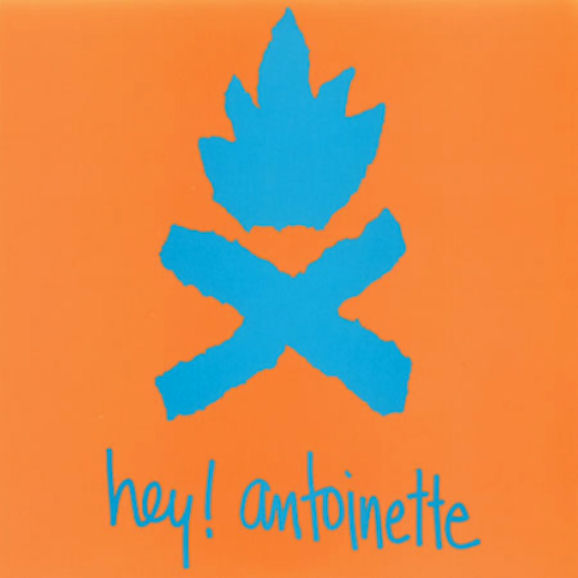
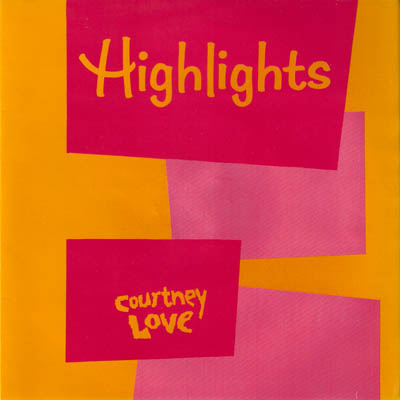
The wonderful Lois Maffeo has made a number of great records, and some of the best were the singles that she made under the name Courtney Love. As a gag it's not bad as Maffeo's gentle acoustic pop songs are about as far away from the real Love's aggressive antagonism. Maffeo's work has always followed a simple template, lovely ramshackle 2 minute indie-pop songs based around her warm voice and jauntily strummed guitar. It's all endearingly amateurish-sounding (although having seen her play a couple of times, it was clear that it took a lot of skill to sound this off-hand) and the Courtney Love singles are great. Lead song from the 'Hey! Antoinette' 7" (1991) is a wonderful little indie-world dissection and of the other two songs 'My Last Night' is a charm. The 'Highlights' 7" has three more great songs, the lead being particularly good and 'Shaniko' a close second.

The mighty Don Covay seems to have been relegated to a soul also-ran these days, which is a total mystery considering the blistering early output by Covay and his band. Their first three albums are superb pieces of raw and direct soul and R&B of the like that was rare at the time and rarer since. The 2007 compilation Platinum Collection covers strictly that early part of Covay's career (1964-1969) and highlights just what remarkable stuff he was putting out. What is particularly extraordinary about his work is that the kind of blues based R&B and soul that Covay specialised in was being recorded in a lush, string-laden style, particularly by Covay's label Atlantic, but there's none of that here. This is Covay and his band blasting out this fantastic stuff with no messing about, it's completely direct and, with the exception of the occasional appearance of a brass section, it's just what it is. In some ways it's therefore no surprise that Covay worked, and often wrote, with Steve Cropper who was a fan of this unfussy way of recording and playing. There are, of course, a handful of dud tunes (and Covay lost his way dreadfully in the 70's), but that's just the nature of the catch-all approach that everybody took at the time, and in fact the uncommonly high quality of not just the performances but the songs is another reason to give the early Covay records much more in the way of props than they get.

Next up is the folk curio of Julie Covington's eponymous album from 1978. Covington had done some work on the folk circuit but by 1978 she was known for her work in musical theatre and it seems strange that the album was made at all, let alone in the way it was. The calibre of the people involved in the album is astonishingly high, with Richard Thompson, John Cale, Trevor Lucas, Steve Winwood, Simon Nicol, Andy Fairweather-Low and Chris Spedding playing on it, and Joe Boyd producing. What's surprising then is how mediocre the record is. The opening cover of Richard & Linda Thompson's 'I Want to See the Bright Lights' is lovely, but it's followed by a weirdly inappropriately upbeat version of Sandy Denny's 'By the Time It Gets Dark' (and as we've already seen, nobody should try and cover Sandy) and a gratingly theatrical 'Sip the Wine'. It's a shame because the song choices are diverse and on the whole great (everything from Kate Bush to the McGarrigle sisters by way of Lennon) and the musicians should have guaranteed quality. I think unfortunately it's just that Covington herself is sadly inherently a bit naff.

The breakthrough album for the Cowboy Junkies (at least breaking through into the notice of some indie kids) was their second, The Trinity Session (1988). Recorded in one night with the absolute minimum of instrumental complexity, it's a crepuscular drift through an early Americana take on country rock. Skeletal, sepulchral and morphine slow it's a thoroughly arresting example of how less can be so much more. Margo Timmins' voice is quietly stunning and indeed it's the hushed tone of the whole band that makes the whole thing so captivating - you keep wanting to turn it up to hear just how it was possible to make such a quiet noise. It's a confident mix of covers and original songs, and amongst the covers are the notorious version of the Lou Reed's 'Sweet Jane' and Patsy Cline's 'Walkin After Midnight' (which is transformed into a totally desolate country blues), but in many ways its the muscle flexing originals that are most diverting.

Cranes were a kind of post-Cocteau Twins ethereal dream-indie outfit who vehemently refuted any attempts to call them goths. They were goths though really. I always found them a bit difficult to like, mainly due to singer Alison Shaw's peculiarly high childish voice, but their 'Tomorrow's Tears' EP I really liked, and still do. The lead song is a quiet, slow, delicately phrased tune with a repeated piano motif and a sort of lullabyish feel to it. The other three songs are a bit truer to their standard output, dark, gothic indie-rock with a heavy emphasis on repetition and percussion, but nonetheless 'Casa Blanca' is a great song.

Anarcho-punks Crass knocked out a couple of typically aggressive albums before surprising the hardcore punk crowd with the release of 1981's Penis Envy. The vocal and lyric writing duties had passed to Eve Libertine and as a result the macho front gave way to an entirely different take on the role of politics in punk. Penis Envy is a great punk album, and one of the few British punk albums that actually uses the form to discuss politics in a serious and committed way. What also came with this new approach was a determination to add a valuable musical dimension and the previous banging about with a handful of chords and four-four rhythms is replaced with a marked increase in musical complexity. That's not to say that this is some kind of prog-punk, but it is certainly engaged with the whole process of actually bothering to make an effort to make a whole song mean something rather than just being a messy post-pub rock musical backing to someone shouting (there's even a nascent Stereolabishness to 'Health Surface'). It's not an easy record to love (it's not exactly a great record) but it is an honourable one, and bearing in mind they were very few and far between in the UK punk scene, I think it's worth its weight in gold.

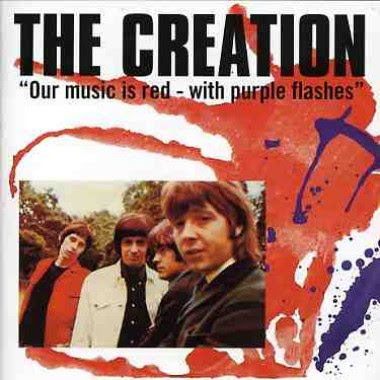
Our Music Is Red - With Purple Flashes (1998) is a compilation of all the 7" A and B-sides that the Creation released in their short-lived career from 1966-1968, together with six other rarities from the time. It's interesting to note how much they crammed into their two years, stylistically speaking. They had a go at everything contemporary, with a remarkably high level of success. So we've got original songs in the mode of the Who, the Rolling Stones, the Kinks, etc, and there's a nice dose of psychedelia thrown into the mix for good measure. It's all great, highly stylised 60's fare and it's pleasingly at the rough end of performance - the Creation had a good deal more in common with the Kinks in that respect than sops like the Beatles.

Monday, 11 June 2012

LaRM day 92 (Elvis Costello)

The bridge between the first and second stages of Elvis Costello's career is the stylistic shift of Almost Blue (1981) and the single that preceded it, 'Good Year for the Roses'. As the sleeve notes of the album warn, it contains "country and western music which may offend the narrow-minded". Well, the problem really is that although Costello clearly has an appreciation for country music it simply doesn't suit his delivery and although songs like 'Motel Matches' from earlier albums hinted at a country influence, they were still undenibly Costello. Almost Blue on the other hand is simply a dedication to a musical style that he likes and as such it falls pretty short in terms of quality. There are some nice attempts at stuff like 'Sweet Dreams' and 'Colour of the Blues' but on the whole it's an overblown and underachieving affair.

The second stage really starts with 1982's Imperial Bedroom. The higher production values and intensely structured songwriting mark out Costello's intention of staking a claim to the status of classic songwriter and the album, against the odds, benefits enormously from the grand ambitions of all involved. The songs really are great, massive demonstrations of the power of ego and talent combined. From the dark undertones of sinister opener 'Beyond Belief' to the brilliant pop formalism of 'You Little Fool', the various shades of rock music as smart-arse pop are given free rein on Imperial Bedroom and although there are occasions when the technicality of the execution overwhelms the songs ('The Long Honeymoon', 'Kid About It', 'Town Crier'), in various ways it represents the peak of Costello's talents. The extras on the CD reissue are pretty good and show that there really wasn't much fat in terms of what was recorded for Imperial Bedroom, it was pretty much all decent stuff. The fussy overproduction continues with Punch the Clock (1983), but this time round the songs are starting to get a bit saggy and the synth heavy production is cluttered and messy, making Punch the Clock a fairly dated and unenjoyable listen. There are some great songs ('Everyday I Write the Book', 'Mouth Almighty' and especially the glorious and furious 'Shipbuilding') but the whole thing is too heavy and dense and most of the songs are forgettable at best and in some ways the signs are there that Costello should have left off recording while dealing with the various personal issues he was contending with at the time.

The first album that I haven't got is the universally derided Goodbye Cruel World, so we skip straight on to Costello's triumphant creative renaissance, 1986's double whammy of King of America and Blood and Chocolate. King of America is Costello's Attractions-less reinvention of Get Happy!'s stylistic grasshopping and it's a wonderful record. The cues are less obviously soul and R&B this time around, but to a large extent his beloved country & western instead. The C&W on King of America is telling, Costello's original country tunes are leagues better than his covers on Almost Blue, and it's the confidence on King of America that is so reassuring. It may be that stripping back the early 80's production and focussing on getting the songs right allowed him to feel more comfortable, but whatever the case, it's a much more enjoyable record and a considerably better one than anyone would have expected at the time. There are a couple of missteps (an ill-advised cover of 'Don't Let Me Be Misunderstood' for example), but they are rare and when there are songs as good as 'Indoor Fireworks' a couple of duff moments are easily forgiveable. Better yet though is the album with the Attractions, Blood and Chocolate. It's an appropriate title, the sound is thick, sludgy and ragged and it suits the tone of the dark, sinister songs absolutely perfectly. And what songs these are, vicious, biting slabs of enigmatic misanthropy, set to some of Costello's most energised and exciting music in ages and you can't help but think that a couple of years apart must have allowed Costello and the Attractions to revitalise. There's no trace of country and western here, and no sense of production at all let alone overproduction, it's simply rock music at it's most simplistically caustic. It's really fabulous stuff. The extras on Blood and Chocolate are a bit less impressive though.

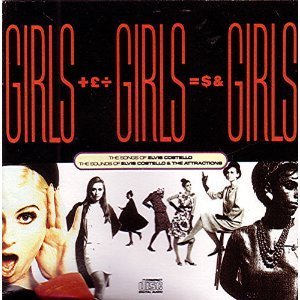
Next up is the 1989 compilation Girls Girls Girls, which is a great double album comp covering Costello's career to 1986 but everything on it has been covered by what we've already listened to, so it's on to the final bit of Costello, 1989's Spike. Spike is a mixed bag and it's also a victim of a difficult trend in the late 80's of having single albums reaching an hour in length, which is always too much. It's an exhaustive, exhausting listen, not least because the songs are not Costello's finest. There is some entertaining vitriol (his anti-Thatcher number 'Tramp the Dirt Down' is great) but on the whole it's a long way from the quality of his best work. That said, it's a lot smarter and a lot better structured and pieced together than most records of the time, but perhaps that's its downfall - it's just too adult an album. And that cover, good lord....

Friday, 8 June 2012

LaRM day 91 (Elvis Costello)

Lots of high quality Elvis Costello today, beginning with debut album, My Aim Is True (1977). It took me a long time to get to grips with the old-fashioned rock and roll stylings of My Aim Is True. Of all Costello's albums it's the closest to the original Stiff records schema as set out by Nick Lowe, Rachel Sweet, etc. The Buddy Holly look and the geek stance, it's all a bit arch, but there's just no denying how superb most of the songs on My Aim Is True are. The best by far are the ones that point to where Costello would go next with the Attractions - 'Alison', 'The Angels Want To Wear My Red Shoes', 'Less Than Zero', they're all ace. The duds are those that stick closest to the rock and roll format, and so tunes like 'Sneaky Feelings', 'Mystery Dance' and 'Blame It On Cain' still leave me a bit cold. When it's good it's really, really good though. Pretty much simultaneous to the release of My Aim Is True, the non-LP single 'Watching the Detectives' was released. As a slight anomoly for Costello's style at the time it's a strange but classic pop song. The faint reggae traces in the background really drive the song and it's no surprise it was a big hit at the time, in a way that none of the songs from the album could have hoped to be. All the Costello albums I've got are late 90's CD reissues with tons of bonus material and the extras on My Aim Is True are interesting but highlight the rather quaintly old-fashioned style in which the songs were originally structured and it's not stuff that appeals to me much.

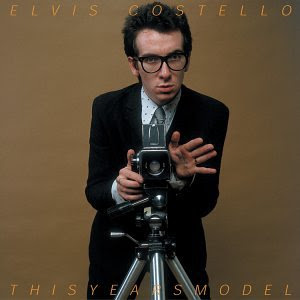
Second album (and first with the Attractions), This Year's Model (1978), I consider to be a dramatic leap forward with much stronger songwriting and a much more singular identity. There's some absolutely fantastic stuff on This Year's Model. In fact there's not a single low point, and from the second 'No Action' starts you can hear how confident and brutally self-assured Costello and his band were. The pace never lets up and neither does the vicious sarcasm, the arrogant musicianship and superb songwriting. Costello's lyrics are at their biting best and pretty everything that happened in the smarter end of Britpop was ripped off of This Year's Model (but obviously done much worse). It's an absolutely invigorating pop record with absolutely no cracks in its bloody-mindedness. Song after song is a belter, 'Pump It Up', 'You Belong To Me', 'I Don't Want to Go to Chelsea' it's an album almost overloaded with great songs. Amongst the bunch of extras is the grand non-LP single 'Radio Radio'.

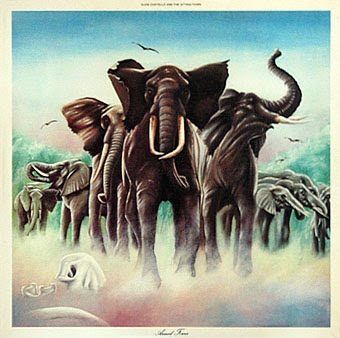
A slightly more mixed affair, but still mind-boggingly confident, is follow-up Armed Forces (1979). The best stuff on Armed Forces is some of the best of Costello's entire career ('Green Shirt', 'Big Boys','Party Girl', all absolutely fabulous) but the erratic stylistic focus means that it's hard to really get a handle on the album and it sometimes feels more like a compilation than a unified album. The down moments can be a bit trying ('Goon Squad', 'Two Little Hitlers') and it's an album that sometimes feels a little like it's over-reaching. However, those quibbles inaccurately imply that it's not a superb album - it is a superb album. The extras are less impressive than those on This Year's Model but they're still pretty ace with a great extended live version of 'Watching the Detectives' amongst the various B-sides.

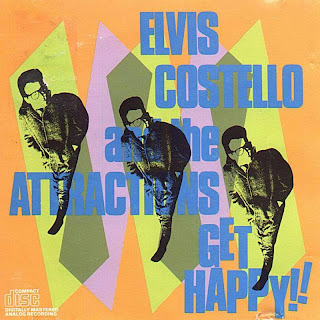
Perhaps the highlight of Costello's album work was the massive show-off of Get Happy! (1980) in which he demonstrated that virtually no form of pop based music was outside his remit or his ability. Most of the songs on Get Happy! barely last longer than two minutes, there are 10 songs a side and each one is a golden nugget of pop smarts. The soul and R&B influences which stand proud throughout the album are nonetheless filtered through Costello's nerdy white boy persona and every song is a testament to being clever enough to fully understand the intent behind your influences while having the self-confidence to bend them to your own will. These are just great pop songs and the whole album is one of the best of its period, standing outside the prevailing post-punk trends while not conforming for one second to anyone else's notion of what rock music should be doing at that time. The extra eleven tracks (31!) on the CD include some decent B-sides and rarities, including Costello's version of 'Girl Talk'.

Last up for today is 1981's Trust, which is in some ways the last album of the early phase of Costello's career, and the last that follows for the most part a particular type of new-wavy sound and general style. Trust is possibly the weakest of the first five albums overall but it does still have some fantastic songs in 'Clubland', 'Lovers Walk' and 'New Lace Sleeves'. In fact the only reason it seems like a slightly weaker entry in the Costello canon is because familiarity has started to set in, the album itself is actually remarkably strong for a fifth album in as many years. There are some treading water moments in 'Luxembourg' and 'Different Finger' and to my mind the torch song effort 'Shot With His Own Gun' is a misfire (sorry). There is an overall sense of bitter cynicism to the album also, probably due to the heavy drinking and political frustration the whole band were indulging in, combined with Costello's determination to prove that whatever any other bands were doing at the time, he could better (hence a number of the songs on Trust being modelled on songs by XTC, the Police, the Pretenders, etc), but in truth he was always best at doing his own thing. Nonetheless, it's still a fabulous album that in some ways seems to improve with age, as our collective cynicism scales the heights of Costello's.

Thursday, 7 June 2012

LaRM day 90 (Alice Cooper-Cosmetique)

So after a few days rest and relaxation it's back to work and back to Alice Cooper. The Life and Crimes of Alice Cooper box set (1999) covers Vincent Furnier's entire career to that date. The first of the 4 CDs is great, covering the first seven years and the Beatles rip-offs that he started his career with (with his band The Spiders) are really entertaining. The stuff on this first CD charts the entire development from cutesy pop-rock outfit to shock-rock lite-metal and is therefore far and away the most interesting. There are some nice demo versions and good selections from Pretties For You, Easy Action, Love It to Death, Killer and School's Out. The second CD has some fantastic stuff on it too, starting with some good choices from Billion Dollar Babies, interesting demos, and odds and ends (the songs he recorded as Flash Fearless Versus the Zorg Women are superbly rubbish), but it all starts going pear-shaped towards the end, with reminders of how lacklustre Welcome to My Nightmare and Goes to Hell are. And from here on in it's increasingly disastrous and there's very little to the third and fourth CDs to write home about. There are some ghastly collaborations (Rob Zombie - blurgh, and utterly inexplicably the Bee Gees) and terrible album tracks from Raise Your Fist and Yell, Hey Stoopid and Trash, but the fact that most of his albums after Goes to Hell only get one or two tracks shows that everybody knows these records are pretty bad. There are some interesting rarities amongst all this stuff but they aren't actually any good and by the time Vincent had started being essentially a cabaret act the Alice Cooper records clearly became a poor second in terms of priorities.

That took a few hours so only time for a couple more, starting with Julian Cope's second solo album Fried (1984). Fried is a legendarily messy and unpredictable record, and one which makes it's unconventionality clear from the cover photo onwards - Cope is shown playing with a toy truck on a slag heap wearing a giant turtle's shell instead of any clothes. Musically Fried is a mix of the kind of clear pop sensibility he showed off in the Teardrop Explodes and a light-headed psychedelia. There are the obligatory backwards guitar solos and unexpected time changes, but the sense of melody is paramount throughout and despite Cope's own clear efforts to sabotage the pop song elements of the record, it's all shot through with great melodies. It's a lo-fi, low-key affair, especially when compared to the ill-judged grandstanding of the records he released either side of it (As the NME described them the vainglorious World Shut Your Mouth and Saint Julian), and it has a much more endearing feel to it than any of his other albums in my view. This is helped a lot by Kate St. John's charming woodwind work which gives the whole thing a delicately pastoral feel which suits Cope's style surprisingly well. I've always found Cope difficult to like on the whole but Fried is a curiously lovely record and one that I always enjoy a lot.

Next should have been the Boxtruck 7" (1993) by Coral but there's no tracking it down on the internet as far as I can tell, so it's on to the debut album by one-time Hoxton hipsters Cosmetique. I Was Born in a Disco Fun Pub (2002) is simultaneously an infuriating demonstration of the casual arrogance of hipsters and a great piece of super lo-fi electronica. These are dismal pop songs which have an air of sticky pub carpets and smelly "cool" dives and are perfect evocations of the kind of pretence that the Shoreditch kids were desperate to affect back in the day. All of which means that it should be a truly godawful album. But it really isn't. The songs are really good and the irony is so very arch that it's genuinely engaging rather than smug. The affected vocal indifference and loose musical delivery (it's all cheap drum machines, broken keyboards and home 4-tracked acoustic guitars and bass) are all part of its charm and there's something indefinably on about the whole thing.

Friday, 1 June 2012

LaRM day 89 (Ry Cooder-Alice Cooper)

The last bit of Ry Cooder is the sprawling compilation The UFO Has Landed (2008) which covers his entire career and includes songs and tunes from most of his solo and soundtrack releases, and is a useful reminder of why I should pick up the stuff I haven't already got. It's a pretty eclectic selection, leaving out most of his most famous songs, but it's a great general overview of the diversity of his stuff and the tunes from early albums Boomer's Story and Paradise & Lunch are especially good.
LinkAlice Cooper's first album, Pretties For You (1969) bears almost no relation to the cabaret metal act that we all know and (sort of) love. Instead it's a valiant but ultimately insipid psychedelic rock album, which is fairly light both in terms of songwriting and performance. It is quite endearing in a forgettable sort of way, and in some ways it's rather charming, but there's not much going on that other psych acts weren't doing better and it's not got anything that hints of the direction they were going to take. The first faltering signs of the hard rock future appear on second album Easy Action (1970). Some people think Easy Action is one of the great lost rock albums but that seems way over the top to me. It's a great record certainly, but it's no masterpiece. It's still clearly indebted to the acoustic and psych scenes and those elements are not greatly improved upon, but it does have some really serious rock action - 7 minute closer 'Lay Down and Die, Goodbye' is the first truly Deep Purple-ish heaviosity (although still greatly suffused with Jefferson Airplane psych experimentalism) that Alice Cooper indulged in and it's great.

I haven't got the big crossover album, Love It To Death so it's straight on to the first big seller, Killer (1971). Killer starts with the superb blues-riffing 'Under My Wheels' and it's clear that this is the Alice Cooper that we're all familiar with. In some ways Love It To Death and Killer show just how much influence a producer has over a band's future. Bob Ezrin stripped out all of the psychedelia and all of the floweriness that had been such a fundamental part of the first two albums and left only the straight down the line rock and roll. I guess it meant sacrificing an interesting side of the band but it certainly meant that they were able to create a specific and identifiable sound. All of the songs on Killer are really solid, a few fantastic - 'Halo of Flies', 'You Drive Me Nervous', 'Dead Babies' and the title track are all brilliant bits of shock-rock, which although musically sound rather quaint now, still work as grand bits of blues based hard rock. Even better is 1973's Billion Dollar Babies (we've had to skip over School's Out, I haven't got it). Billion Dollar Babies is a quintessential early 70's rock album. It may not sound particularly hard now, but it is vicious, mean-spirited and wiry, and it's really quite brilliant. There are some big hits here ('Elected', 'Hello Hooray', 'No More Mr Nice Guy') but it's more than the sum of its parts. The guitar solo on the title track is a brilliant example of strung-out rock excess and Vincent himself is in incendiary form. Realistically this was the tipping point after which the band went from interesting and genuinely great shock-rock act to silly cabaret pop-rock, but as a last truly great rock album from the band it's worth its weight in gold.

Five days off now, so back on Thursday for the five hour box-set, The Life and Crimes of Alice Cooper, which is a curate's egg to say the least...