Tuesday, 11 September 2012

LaRM day 138 (Esben & the Witch-Even As We Speak)

Goth me up to the max, it's patchouli revivalists Esben and the Witch and their 2011 debut Violet Cries. These are dense, dark songs, that sound a bit like a walk through a wintry twilight forest. See, that's the kind of daft imagery that this stuff is about (or is it just because that's what's on the cover?). It's very serious, it's pretty gloomy and it sounds absolutely like a less wilfully esoteric take on Siouxsie and the Banshees. To be fair, as a kind of post-shoegaze swirling guitar goth revivalism goes it's really pretty good, and where they've been very smart is in keeping the production relatively contemporary, meaning that what could have been a very naff record indeed actually sounds surprisingly fresh. It's no world shaker by any means, but it's a lot better than realistically it should be, and as someone who never found it hard to like goth with female vocals, I think it's a fine album.

Sticking with the creepy, spooky theme, but of a very different kind, it's America's premier freak-folk outfit, Espers. The self-titled debut album was released in 2004 and heralded a whole new aproach to playing folk music which drew from a wide array of interesting sources. The most obvious is the odder end of traditional British folk, but there's stuff from the whole history of American rural music, Scandinavian folk and psychedelia too. It's properly witchy stuff and absolutely superb. The idea that they were involved in creating new music for Eastern European 70's freak-out movie Valerie and Her Week of Wonders makes absolute sense, because Espers records are the aural equivalents - disconcerting, disturbing but truly beautiful pieces of work which challenge categorisation so vigorously that the term freak-folk has pretty much been built up around them. As far as studied, arch and deliberately odd folk music goes, this is as good as it gets. Meg Baird's voice is perfectly pitched for this kind of stuff and she often sounds like something from an imagined history, and indeed much of the music sounds like it has come from an alternate version of the past.

Espers III (2009) is dramatically different to the debut album. It's a much bigger, fuller sound, and the spooked out campfire feel of the first album is replaced by a greater emphasis on the full band psych-folk approach. It's another very fine album and it feels much more confident. In some ways it's a shame that the tremulous creepiness of the debut has gone, but it's best to view the two albums as very different types of records rather than compare them against each other, and the more expansive feel to Espers III is fantastic in its own right. Meg Baird and Greg Weeks' voices complement and oppose each other throughout in a much more sure fashion and the whole band sounds like a collaboration between the United States of America and Pentangle. Now for some people I guess fusion-folk and psych-rock as a combo would be a nightmare come true, but honestly, this stuff is superb. What's particularly interesting is how timeless it sounds though, particularly bearing in mind that its source materials are all of specific times and places.

For a change of mood and style let's dig one of the greatest singles of the 1970's, it's David "bog's like a palace" Essex and the untouchably perfect 'Gonna Make You a Star' (1974). What a song. What a fine, fine song 'Gonna Make You a Star' is. It's brilliant, perfect grimy pop with a surface sheen, it's the kind of thing that nobody would even think of doing these days, and to think that it complements two of the scuzziest Brit movies of the 70's in which Essex stars (That'll Be the Day and Stardust) adds to its brilliance. B-side 'Window', however, is shit.

More 60's revisionism now with Elephant 6 outfit The Essex Green. Like their sister band The Ladybug Transistor, The Essex Green trade in a kind of bucolic, pastoral psych-folk-pop which is always charming if occasionally a little too winsome or whimsical for its own good. The self-titled debut mini-LP, released in 1999 sets out the stall in a somewhat lo-fi and low-key way, with its obvious psych-pop influences worn proudly on its sleeve. The five songs are wistful and calm, and indeed one of The Essex Green's great strengths is their casual charm, never hurried, never forced. The first full-length album, Everything Is Green (1999) is a little more cleanly produced and has some fantastic songs on it, from the Free Design-ish 'Playground', to the swirling Hammond and fuzz guitar workout of 'Tinker', it's all great stuff and the homage to their favourite decade 'Sixties' makes expressly clear just who, where and when they want to be. The fact that the lovely Sasha Bell takes an increasingly prominent role on the albums goes some way to explaining why they become more melodic and poppy and less psych-folk with each release. Her charmingly artless voice makes for a perfect lead for second album The Long Goodbye (2003) and its endearingly sunny 60's pop-folk. I remember when people used to rave about The Beachwood Sparks and listening to The Long Goodbye again today just reminds me how much better The Essex Green were. 'The Late Great Cassiopia' is one of the great lost indie-pop songs of the 2000's but The Long Goodbye has a bunch of other equally loveable tunes.

Good Lord Annie Lennox has made some dreadful records over the years. After the dismal pop-punk of the Tourists she and Dave Stewart (a man so gruseome looking that Zo actually gags when she sees him on the TV) formed the almost as dismal Eurythmics who made some truly gruelling bits of synth-rock spread over the 1980's. However, there is one peculiar anomoly in the Lennox catalogue in my view, and that's the third Eurythmics album, Touch (1983). Touch, while still clearly recognisably a Eurythmics album has such an odd feel to it and such great melodies turned to such unexpected effect that it seems to me to be a genuinely great record. With the sole exception of the hugely irritating synthed steel drum workout 'Right By Your Side', every song on the album has something about it - not that they all work but even the failures are at least interesting and even when the album seems corny there's a strange arrangement or set of funny noises going on. It's a chilly album, deliberately off-putting and haughtily disdainful and again with the exception of 'Right By Your Side', it feels as if it doesn't care whether you don't like it. Maybe that's why I do. The version of the album that I've got has a bunch of B-sides and live stuff all of which are fairly terrible, and an unforgivable cover of Bowie's 'Fame'.

Next we have one of those simultaneously great and terrible proto-Nashville country records by a giant of the pop-country scene. This time it's No Place That Far (1998) by Sara Evans. I have no idea why I sometimes like this kind of horrible pap, but there's no getting round it, it's a fact that I do. No Place That Far actually has buried under its many layers of processed production and right-wing country songwriting a tiny vestige of real country, a sliver of bluegrass styling. Surprisingly, this tiny bit of honesty comes from Evans herself - her first album was a decent post Garth Brooks bit of bluegrass honed country-pop and the inflections in her voice still reveal her history and her initial influences on No Place That Far. By the next album every last trace of real country music and emotional honesty have been efficiently eradicated (and it would appear her, to that point, perfectly normal figure reduced and enlarged in specific places by the surgeon's knife), but there's still the faintest pulse of something real at the heart of No Place That Far if you can bear to try and find it.

And we finish with a blast of Australian sunshine pop courtesy of the short-lived by eternally charming Even As We Speak and their sole album, the appropriately titled Feral Pop Frenzy (1993). A bracing, brisk collection of two minute indie-pop guitar workouts, Feral Pop Frenzy is a brilliant demonstration that you can be straight down the line with a pop melody while being a little experimental with the form. In amongst the pop nuggets are some weird little acoustic numbers and some downright bizarre spoken-word pieces, which make the album more than simply a pop fizz. It's still that though and songs like 'Falling Down the Stairs' and 'Straight as an Arrow' are as pop as you can get in the indie world. It's brilliant fun stuff and although it sounds very much a product of its time, it still sounds great.

Monday, 10 September 2012

LaRM day 137 (Brian Eno-Eric's Trip)

Last few Eno albums today, starting with the second collaboration with Harold Budd, 1984's The Pearl. Although unsurprisingly very similar to The Plateaux of Mirror, The Pearl is slightly more robust, and Budd's gently hypnotic piano motifs are less distant. As a result the album sounds less like the health club background music than the earlier record and it's much easier to listen to the simple beauty of The Pearl without thinking about hot stone treatments. It really is a very lovely record, graceful as the best of Eno's production always is, approachable and warm, evoking specific atmospheres, specific images appropriate to the titles of the pieces. In many ways it's one of Eno's finest ambient albums. However, the one that works best for me is the follow up solo album, Thursday Afternoon (1985). Very similar in fact to The Pearl, Thursday Afternoon is a single hour long piece of distant synth washes behind extremely spacious piano notes. It's the best of Eno's self-generating works, certainly, but it's also the closest that his work has ever come to being a specific collaboration with the listener. Thursday Afternoon works something like a novel, in that the only way to experience it is to interpret it, you can't just have it on because it'll vanish from your notice, the only way to get anything from it is to engage with it. Therefore, it's either stunningly beautiful, contemplative music or else it's mind-numbingly boring. My view is the former.

After a pause in recording Eno went back to the studio in 1990, this time with the great John Cale to see if they could come up with something as good as Cale's Eno produced 1974 album, Fear. Instead what happened was that they fell out spectacularly and ended the process absolutely hating each other's guts. What's particularly odd about this is that the album itself, Wrong Way Up (1990), is a really spritely, jaunty collection of pop songs. For once Eno's production ideas went a bit wrong though and the whole album sounds too glossy and for a lot of its running length, rather badly dated. This is a shame because the songs themselves for the most part are the results of the combined strengths of two great songwriters and are really good, really likeable tunes. Cale's instinctive knack for an off-kilter pop melody and Eno's skill at making everything sound warm and engaging are both at work on Wrong Way Up. Finally we skip over Eno's work of the next eighteen years and have 2008's second collaboration with David Byrne, Everything That Happens Will Happen Today. In some ways it's an album cursed by its creation, because at no point in the future will anybody say that it's an album that changed music in the way that My Life in the Bush of Ghosts did. Nonetheless, if you put that remarkable work to one side and judge Everything That Happens Will Happen Today by its own merits, it's a really great record. Byrne's rather forlorn lyrics and melodies are superb and Eno's production creates a really lively and brisk pop sheen, in the best possible sense, over the whole thing. It's a mature record certainly, but it's far from dull and although both men's days of breaking new ground are realistically long over, they're still more than capable of making effective and affecting records that are still better than pretty much anything anybody else is doing.

Before Destiny's Child plagued us with their terrible records, a much better precedent had been set by the ridiculous En Vogue. Funky Divas (1992) is a truly appalling record of cheesy funk, soul and R&B, the songs are dodgy at best, the performances pretty weak. But, and this is a big but, there's something that seems in comparison with the hideous versions of this that get released these days, rather honest and likeable about Funky Divas. It's feels far less aggressively cynical, you can almost believe that both the band and the producers wanted to make something real, a record that people genuinely had a reason to like. It's rubbish, obviously, but I can't help but feel nostalgic for a time when records that wanted your money tried to win you over rather than just rifle through your pockets.

Next up is an early Merge records single by Erectus Monotone called Cathode Gumshoe (1991). I can only find a couple of tunes from it on the internet but they're really good tiny little bits of punky super lo-fi pop.

Finally there's some more lo-fi indie rocking from Canada's Eric's Trip and their third and final album, Purple Blue (1995). Eric's Trip didn't allow borrow their name from Sonic Youth, they used pretty much every other guitar based fuzzy indie rock act to borrow and steal stuff from, and although there's virtually nothing on Purple Blue that hasn't been done before by someone else, it's still a good album, with some great scuzzy indie rock shapes on it. The fact that Rick White and Julie Doiron had different influences helps to ensure that there's a variety of stylistic ripping off going on throughout and on the whole listening to Purple Blue is like taking a highly enjoyable one album road trip through the entire indie scene.

Friday, 7 September 2012

LaRM day 136 (Brian Eno)

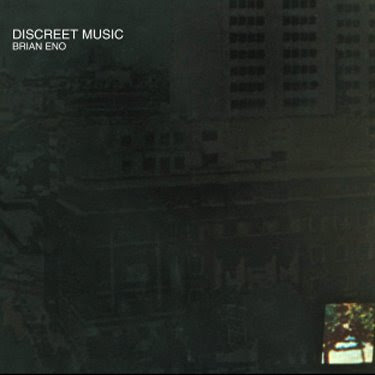
Another whole day of Eno magic today, starting with the avant classical Discreet Music (1975). A kind of chamber counterpoint to Another Green World's electronic composition, Discreet Music is much more directly associated with the deconstructivist agenda of John Cage and his contemporary experimental classical composers. Four stately pieces, the first of which is half an hour long, and all of which explore in different ways the spaces between notes as much as the notes themselves. Far too rigorous and intellectually engaged to be ambient music and too dedicated to repetition and minimalism to really be classical composition, the pieces on Discreet Music are instead a kind of smart-arse mood work. That's the real key to Discreet Music I think - it may be austerely brainy but it's also strangely moving. All four have a varying degree of melancholy about them which is both engaging and affecting.

Before disappearing entirely into abstracted atmospherics, Eno had one last hurrah with quirky pop music by spending 1976/77 in Berlin with David Bowie and Iggy Pop, overseeing their greatest records as well as making one of his own. Before and After Science (1977) is structured similarly to Bowie's Low and Iggy' The Idiot, having a first side of odd pop songs and a second side of more abstract tone and mood pieces. The pop songs on Before and After Science are really great, from the stuttering 'No One Receiving' to the clattery Talking Heads tribute 'King's Lead Hat' (a couple of years later Eno would help to turn the Talking Heads from one of the most interesting post-punk bands into one of the most interesting bands full stop), and each one has a clear character and a clear sense of construction. They're by turns peculiar, whimsical, frustrating, and all great. The bridge between the sides is the languid straight pop song 'Here He Comes' which is a hazy, delicate song which wouldn't have been out of place on Another Green World. From then the album stretches out into the calmest, most serene pieces, some songs, some instrumental, with some fabulously delicate chord changes and progressions which are not only brilliantly clever, but also calming, moving and entirely warm. It's a really wonderful album.

1978 saw a return to the kind of atmospheric ambient approach of Discreet Music, but refined to absolute perfection. Ambient 1: Music for Airports (1978) is a truly astonishing piece of work, subtle, delicate, graceful, fluid and assured, its stated aim to be specifically background music is misleading. This is some of the most beautifully designed, rigorous avant-garde composition around. The first of the four pieces '1/1' is 18 minutes of subtle pastel shaded synth distantly underscoring a repeating but ever evolving single piano motif. It's hypnotic and extremely clever, like a less formalised interpretation of repetition that Steve Reich was exploring at the same time. The second '1/2' is shorter and less graceful, being synthesised voices repeating and evolving a worldess motif. In some ways the greatest piece is the last which is ten minutes of shifting thick keyboard waves which rush in and recede, and it is the most clearly the result of tape loop recording, as parts rise up and degenerate to allow others to wash in to take their place. Despite the noise being thick and faintly sluggish, it's still incredibly engaging and oddly moving.

I think people really rate 1978's other ambient project, Music for Films, but I'm not sold on it myself. Music for Films has 18 brief pieces which, mainly because of their brevity, sound more like sketches of melodic ideas than whole completed pieces of ambient or mood music. Some of them are unsurprisingly lovely ('Events in Dense Fog' is wonderful, creepy and uplifting by turns), but the whole thing has too much of an air of Windham Hill recordings about it. As does, but for very different reasons, 1980's collaboration with Harold Budd, Ambient 2: The Plateaux of Mirror (that title just led to Zo dubbing Eno "a twat". Unforgiveable. But sort of understandable). Anyway, Ambient 2 is the first album on which Eno gave Budd his trademark echoing gentle piano sound, and in 1980 it would have been pretty unusual. It's undeniably stunningly pretty, but it's a sound whose revolutionary appeal would have been very brief indeed as the co-opting into being used as the soundtrack for everything sedate, from TV adverts to background music in health spas, was fairly instant. It means it's hard to listen to any Harold Budd records without having those thoughts about them, which really is a great shame because objectively they are stunningly attractive and evocative records.

The production work Eno had done for the Talking Heads over the preceding three years had led to conflict within the band who felt that David Byrne had fallen too much under Eno's spell and had left the band's original ideas behind. If anything their concerns were consolidated by the release of 1981's My Life in the Bush of Ghosts, a collaboration between Byrne and Eno. The band may have been right to worry but sadly their loss was the world's gain because not only did Eno turn the Talking Heads into one of the most unique and uniquely interesting bands in the world but My Life in the Bush of Ghosts was a game-changing masterpiece. "World music" before the term had any currency, the album is a fantastical journey through the musical world channelled through the experience of television. I think the idea is that TV allowed access to the whole of the rest of the world and its various cultures, through a distorting lens without question, but access nonetheless, and the album throws everything it can into the pot. The rhythms are all essentially Middle Eastern and African, there are chanting Imam's, there's South American percussion, funk bass, choppy African guitars, endless samples from US TV of preachers and salesmen, and the whole thing is stitched together seamlessly. The fact that everything is mixed in together with nothing venerated, nothing given precedence, and all of it slightly inauthentic makes the feeling that it's musical channel-surfing entirely plausible. It's an extraordinary record because not only is it astonishingly clever, completely without precedent at the time, it's also amazingly listenable, and the first in particular is loads of fun. (My copy is the Nonesuch reissue, hence the new cover, which has a handful of added scraps of songs that didn't make the final album which are interesting but inessential)

Ambient 4: On Land (1982) is another superb collection of atmospheric pieces which gently unfold throughout their running time. This time out the music seems to have been played directly and organically rather than with heavy processing or using tape loops and as a result the sound is both more immediate and more human. There's something a little sinister about some of the sound of On Land and for me it sits somewhere between being too winsomely Windham Hill, and not quite spacious enough. Unlike Apollo: Atmospheres and Soundtracks (1983) which I think is possibly Eno's greatest ambient work. It's absolutely stunning, the cover setting out the theme of the record. I believe it actually came out of a commission to compose the music for the great NASA doco, For All Mankind. As a soundtrack to space it succeeds wonderfully and between 2001: A Space Odyssey and Apollo: Atmospheres and Soundtracks, all of the stereotypical notions of the sights and sounds of outer space were created. There's nothing in the album that has any relationship with its theme, of course, yet somehow it really is the sound of emptiness, of weightlessness - it's truly remarkable. And it's another astonishing testimony to Eno's unparalleled skill at constructing entirely new views, entirely new ways of thinking about music as both an idea and as a tool. Apart from anything else it's a stunningly beautiful listen.

Thursday, 6 September 2012

LaRM day 135 (Alec Empire-Brian Eno)

Last of the Empire is the sprawling two hours of Intelligence and Sacrifice (2002). One of my great friend Patrick's earliest tatoos was of the logo for Intelligence and Sacrifice on the underside of his wrist. It looks cool. Anyway, the album itself is split into two distinct halves, the first of which is the closest of Empire's solo records to resemble his Atari Teenage Riot work. In fact it's pretty much an ATR album without Hanin Elias screeching on it. The metal guitar samples and pummelling drum machines are all present and correct as are Empire's barked slogans and muttered doomsday prophecies. It's all absurdly daft and brilliantly enjoyable. 'The Ride' almost has a discernible melody and there are a handful of songs which sound as if they might actually have been put together in a standard songwriting fashion ('Addicted to You' has a heavy-hand riff on 'I Wanna Be Your Dog'). Not really though, because for the most part it's the noise and the sloganeering that count. The second hour of the album is something of a return to Empire's early ambient experimentation. Kicking off with a 30 minute piece which runs the gamut of electronica techniques, the whole of the second half of Intelligence and Sacrifice is for the most part entirely unsuccessful. It's a bland and unchallenging attempt at revisiting the experimental electronica of the early 90's and although it does occasionally succeed in being incredibly irritating (the last ten minutes of '2641998' will make you want to smash your speakers) at no point does it do anything particularly interesting. Some of it's OK ('Cat Women of the Moon' is pleasant enough) but this stuff has all been done before a million times by people much more adept than Alec Empire and it means that 70 minutes of it is a pretty boring experience.

OK so here we go on a 16 album Brian Eno odyssey. For the sake of getting everything in, I'm including all Eno's collaborations with other individual composers under his name, even if he's credited second, so that means that we start with 1973's collaboration with Robert Fripp, No Pussyfooting. Not the easiest start to our Eno session, No Pussyfooting is experimental composition without compromise and although it does set out Eno's nascent ambient structures it also has a heavy dose of Fripp's absurdly overcomplicated treated guitar work. The first of the two pieces, 'The Heavenly Music Corporation' is pretty lovely though, with Fripp's guitar being treated in such a way as to create some really lovely surging and subsiding drone waves against which he then sets an unusually understated display of his "Frippertronic" reverb drenched, high end soloing. The whole album was recorded using ever developing tape loops and building up sounds on the loop as it came round the tape heads, and it's a clever early demonstration of the potential of such a recording process. The second piece, 'Swastika Girls' though is a little less successful, partly because it is busier and doesn't allow the space for the listener to disappear into that the first piece grants. Nonetheless it's still a fantastically innovative piece of work, indebted far more to avant classical composition then rock music, and besides being perhaps the earliest ambient record as we think of it now it also marked Eno out particularly as a truly creative thinker in a cultural sphere usually unforgiving of real innovation. Also, can anybody explain the cover to me? I get the room of mirrors being symbolic of the tape loop recording system, but why are they playing cards with a deck of nudie cards?? The reissue that I have also includes the whole album played backwards, which interestingly sounds like a different take on the same process, and also 'The Heavenly Music Corporation' played at half-speed which sounds like the ultimate drone experiment and puts most ambient music made since the late 1980's to shame.

And so on to Eno's debut solo proper, Here Come the Warm Jets (1973). This is glam rock as performed by an art-rock cabaret, a superbly uncompromising demonstration that whatever people thought pop music was in 1973, it could be something very different. With a handful of exceptions the songs on Here Come the Warm Jets are relatively straightforward, but musically Eno creates a dense and entirely idiosyncratic set of arrangements in which all instrumentation is manipulated in one way or another to make it sound either other-worldly or else nothing like it originally sounded and as a result the album is a totally free and whimsical approach to pop music unlike any other at the time. The influence of the record has been immense (every element of 'Blank Frank' has been stripped and ripped off a million and one times for instance) and to listen to it now, it still sounds like a leap forward both in terms of how to treat pop songs and how to write and record them. Eno's other relatively clean "pop" album, 1974's Taking Tiger Mountain (By Strategy) is very slightly less well-regarded but personally I actually prefer it. There are more specific and deliberate quirks on Tiger Mountain which I find more exciting than the more broad-brush show-off pop experimentalism of Warm Jets. It's also less joyfully uninhibited, there's a denser, darker mood to Tiger Mountain, and there's also a feeling that the songs were much more closely scrutinised as they were written and recorded. The idea that challenging art-rock could be this accessible and this straightforwardly enjoyable is remarkable in itself, but the fact that unlike a lot of art-rock this is genuinely incredibly clever stuff just makes the whole enterprise even more extraordinary.

Finally today is one of the greatest albums of the 1970's and one of the most important in terms of the vastness of its influence. Another Green World (1975) was the point at which Eno stripped down the melodicism of his pop music and built up in its place the ambient atmospherics that he would go on to explore in greater detail. What's remarkable about Another Green World is the way in which Eno constructs the whole album with such concision and such precise attention to detail, never allowing a tune or song to over-reach or outlive its interest, and so these pieces are brief, there's no ambient noodling here at all, and all highly evocative. There are dark edges to some of these tunes and some are lighter than air, and despite the fact that the sound and tone of each piece is markedly different from the rest, each plays a vital part in the whole. As far as ambient music goes there's too much life, too much melody and too many songs (there are a handful of lovely skewed melodic songs amongst the instrumental pieces on Another Green World) for it to ever be classified as an ambient album and there are too many spectral and atospheric pieces for it to ever be called a rock or pop album. It's a pivotal record which has gone on to underpin whole swathes of musical development and while that's fairly remarkable in itself, Another Green World's greatest achievement is that it has scarcely dated and still sounds fantastic today.

Wednesday, 5 September 2012

LaRM day 134 (Alec Empire)

Some totally ridiculous nonsense all day today with our old chum Atari Teenage Riot's Alec Empire. Having spent a few years noodling around with ambient techno and releasing a number of experimental ambient albums, 1993 was a pivotal year for Empire when, having played a fantastic fast one with his record company and artfully manouevered a ton of cash out of them for nothing (it was a brilliant trick he played), he started mucking around with breakbeats and hardcore samples, creating a superb template for a frantic drum and bass breakbeat built around vicious bpms, arhythms, thrash guitar samples and antique keyboard noises. The first solo output of this stuff was 1996's compilation of session, single and new tracks, The Destroyer. This is a totally invigorating record and one which seemed peerless at the time. Obviously it all sounds rather silly and desperately (even laughably) earnest now, but there's no missing the intention to create an all-encompassing, brain-blasting soundscape in which declarations about how "when you've reached your peak - it's time to die!" almost make sense. There are some pieces which are scuzzed up versions of his previous calmer work ('Firebombing', although dirty and messy, still adheres to the stoned repetition principle), but most of it is blasting, skittering fury delivered as if to a scowling crowd pointing in the air and, as Empire himself would have it, banging their heads. A further compilation of disparate tracks was released in 1997, Squeeze the Trigger, which is basically more of the same, but there's possibly a greater focus on the construction and density of texture of individual tracks but the whole thing feels slightly less passionate, probably because the sources of the material are fairly diverse, and because it's more tightly put together.

One thing that I'll always have a lot of respect for Empire for is his unwavering commitment to opposing the right-wing in the techno community and in the world at large. Often sounding absurd, his passion is unchallengeable and although it often means he sounds extremely silly, I think it's worth remembering that at least he's on the side of the angels and is prepared to be vocal about it. Anyway next up is the three and a half hour long compilation of early Empire material, dating from around 1990 - 1996, called The Geist of Alec Empire (1997). It covers his various ambient and atmospheric experiments before alighting on the blitzkrieg style of breakbeat techno that became his trademark. There's some excellent stuff on here and also some truly dismal nonsense. When it's at its worst it sounds like the laziest stoner student version of every other art-house techno that was doing the rounds at the time, but at its best it shows how thinking outside the box can create intriguing results. There are some muddy, sludgy beats, writhing around in amongst the low-level techno and although none of it has the barrage of noise that he's famous for, there are enough idiosyncratic approaches to the Autechre template on The Geist to put most techno and ambient experimentalists to shame.

Normal service is resumed for the start of the next splatter of noise though. Miss Black America (1999) is one of Empire's funniest and most genuinely unpredictable records, but it starts off straightforwardly enough with 'DFo2', which is trademark Empire, shattering, thudding breakbeats and the man himself shouting about something, socialism probably or how the time is right to fight. But then everything goes a bit odd, with some seriously scuzzy noise experiments, many of which are almost entirely beat free. The fifteen minutes of 'The Robot Put a Voodoospell On Me' and 'I Can Hear the Winds of Saturn' are basically loads of squiggly bleeping electronic noise but recorded with a vicious sheen which almost hurts to listen to. The album as a whole is bit like some kind of psych-techno, with a surprisingly open early Tangerine Dream influence. Much of the album is composed of similar stuff, slow, nasty, noisy constructs which are much more like the stuff of cheap nightmares than Empire's usual blistering, ranting beats. It does however contain the superb '(Untitled)' which is akin to the stuff that Atari Teenage Riot played at the recorded Brixton gig - 6 minutes of hideous, frantic, industrial and electronic noise collaged together with absolutely no sense of melody, rhythm or structure. It's completely absurd and utterly brilliant. Finally for today's Empire fun it's the super limited edition of Alec Empire vs Elvis Presley (1999). This is probably the absolute zenith of both sample culture and cultural appropriation. It's mind-boggling stuff. The whole album is an array of Elvis samples, songs from records and dialogue from movies, pulped and mashed into an absolute malestrom of fractured beats and almost unlistenably muddy electronic noise. It's absolutely brilliant. It's barking mad, totally idiotic, meaningless and at the same time it's probably one of the most profound statements about the post-modern cultural condition ever made. It's the work of a maverick whose one trick finds its perfect expression.

Tuesday, 4 September 2012

LaRM day 133 (Emmy the Great-Emperor)

A day of contrasts today with some whimsical acoustic singer-songwriting followed by some of the most brutal and technically skilful Norweigian black metal. First up is charming folkie-type stylings from Emmy the Great. Zo and I saw Emmy play at the Borderline supporting the wonderful Emma Pollock a few years back and although there were only about six of us there she played an absolutely charming set. In some ways the downbeat coffee house approach that she takes is better served played in person than on record where the songs can sometimes come across as either a bit underwritten or else a little corny. Nevertheless First Love (2009) has some lovely songs and some lovely touches. Despite her slightly middle-class girlish voice there's a direct and often disconcerting approach lyrically and although at first listen her songs sound unchallenging if a little dour, there's actually some interesting and sometimes rather melancholic stuff going on, and for every slightly naff 'On the Museum Island' there's a sparkling 'Bad Things Coming, We Are Safe'. When First Love fails it sounds like something designed to be half-listened to in the car, but when it works it's lovely. Second album Virtue (2011) while being essentially more of the same, is actually quite a step forward. This is due in small part to a clearly substantially increased production budget, but there's also greater attention to songwriting and arrangement on Virtue. It's a shame that Emmy will never attain the instinctive brilliance of Laura Marling but as a second tier version of the same intentions Virtue is a really decent effort. There are strengths in the songwriting that were absent on First Love ('Exit Night Juliet's Theme' and closer 'Trellick Tower' are particularly strong) but the heightened production and more studied approach mean that the charm of the first album is also largely absent. It's not a problem as such, but it does show that Emmy's best bet probably lies somewhere in the middle of the two albums.

So, by a shattering contrast we have Emperor's black metal masterpiece Prometheus: The Discipline of Fire and Demise (2001) which is a blast of absolute Norwegian metal power. This is spiky glove time to the max. Total spiky metal spike, with some serious corpsepaint action to boot. Although to be fair, by the time Prometheus was released Emperor had moved beyond all that dressing up as zombies nonsense and were entirely locked on to the idea of making records of authority. And that's what Prometheus is. I remember a review in Metal Hammer or somewhere that said that if you're genuinely interested in music of any kind then you would have to like Prometheus. It's true. Even if you hate metal entirely the sheer brilliance of Prometheus' construction and performance is still mystifyingly good. It was also way ahead of its time, creating a template for a sort of concept metal which has since become extremely common, and to listen to it now, against Mastodon for instance, it stands up fantastically well. It's massive, crushing, absurdly intricate and, of course, very, very silly, and it beggars belief that apart from the martial thrash drumming it's entirely the work of one bloke (frontman Ihsahn having effectively sidelined churchburner guitarist Samoth). The absurdity of the whole enterprise is demonstrated by the album's opening, being a gentle harpsichord piece which then disappears instantly and immediately beneath a barrage of hyperkinetic drum and thrash guitar. All of the standard pieces are in place really, the growling "sinister" vocals, the shrill speed solos, the frantically unpredictable time signatures, the ridiculous lyrical conceits, but it's all done so, so well and is so inexplicably accessible that it's hard to imagine that it would be possible to top it. 'Empty' kind of shows off with a casual arrogance the ease with which Emperor could do this stuff, while simultaneously either showing off a sly sense of humour or else reaching the heights of daftness by weaving a jaunty chamber string quartet into the frantic metal mayhem. Prometheus is one of those albums that if there's any justice will be rediscovered in years to come and more widely hailed as a truly great piece of work.

And finally for today is the massive Emperor career overview, Scattered Ashes: A Decade of Imperial Wrath (2003) which covers their entire output from 1992-2001. Two and a half of hours of the most inventive and rigorous black metal ever recorded, it serves as an uncomfortable reminder that deeply unpleasant people can still do astonishingly creative things, and I do wonder whether frontman Ihsahn saw the gruesome personalities of fellow bandmembers Trym and Samoth as useful tools for an intellectual project (both Trym and Samoth were involved in variously unpleasant criminal activities and were personally close to both odious fascist sympathising murderers Faust and Varg Vikernes, whereas Ihsahn appears to have had little or nothing to do with the same activities or crowd). Anyway, pretty much all of the material on Scattered Ashes is as good as this notoriously challenging and absurd genre can get and there's no denying the astonishing technical skill involved. The songs aren't arranged chronologically so it's hard to really chart the development of Emperor's sound, although some songs are clearly denser and more smartly constructed than others, but to be honest they were pretty complex and structurally rigorous from the very start. The cover versions and rarities of the second disc are interesting as curios, but the tracks from the proper studio albums are the real meat of the thing and listening to them is simultaneously hugely enlivening and liable to make you feel a bit grubby.

Monday, 3 September 2012

LaRM day 132 (EMA-ELP)

Back after two lovely weeks off and apart from being back at work and nearly being killed this morning, everything is fine. And it's a difficult start to the day with EMA's Past Life Martyred Saints (2011). Tricky record this one, eclectic to a fault and skirting around the edges of being amateurishly corny, when it works it's fantastic and when it doesn't it's dreadful. It's a dense, layered record which often sounds like you're listening to it through a handful of mud. Deceptively starting with the langurous and lengthy but inexplicably forgettable 'Grey Ship', it follows on with a basically spoken word piece with a fractured, bloody musical backing in 'California' which exeplifies the best and worst of what's going on here - the lyrics or juvenile and spiteful without any linguistic grace and little skill, yet weirdly they fit with the superb, brutally abstracted musical setting. And so it goes on, 'Anteroom' is forgettable, 'Milkman' is nastily brilliant, etc, etc. I can see why people were excited by Past Life Martyred Saints, but I've heard some of the stuff that Erika Anderson made before it and I'm not convinced that the good stuff isn't accidental and the dud stuff deliberate.

Next up are some of the stupidest records ever made, and they were made by some really smart people. It would be hard to deny that Emerson, Lake and Palmer weren't immensely talented musicians, but like so many of prog's great proponents they took the view that making music was about showing off skill in a context of skill itself. In the end listening to ELP albums is like reading books by authors with vast lexicographical skill who use it only to show off the words they know (ie most shit sci-fi), and the biggest problem with that really is that there's never even the vaguest hint of self-parody or even self-awareness at work. Therefore ELP's 1971 grandstander Tarkus is one of the most bombastically absurd things ever recorded. The side-length title track being surely the apotheosis of prog, as it's stuffed with nonsensical time changes, purposeless atonality, aimless complexity of structure and a mind-bogglingly idiotic theme. Which is basically that there's a war on between some mythical super-beings (Tarkus and Aquatarkus (armadillo tanks, no lie) on one side, a manticore and some other freak out monsters on the other) in the middle of which sit us poor humans, armed only with arrows and God for some reason. Anyway, it's all errant tosh designed solely to allow for some florid and laughably melodramatic uber-noodling on keyboards. Little could poor Keith Emerson have known that has insanely technical flourishes would often end up sounding like a hyperactive version of the music to Jet Set Willy. Anyway, side 2 has some more formal tunes on it but they're all rubbish, including "light-hearted" closer 'Are You Ready, Eddy?'. a blues-rocker which suggests that ELP's idea of humour would have been sitting around with Rick Wakeman and making vicious comments about their wives. Anyway, despite everything that I've said Tarkus is absolutely brilliant. I'll never forget the first time I listened to it, when Patrick and I had finished prog quest day 1 and went back to his place to listen to what we'd picked up. The look on both our faces at the opening stupid frenzied minutes of Tarkus will always remain a cherished memory.

Less genuinely amusing but still utterly laughable is 1971's other ELP album, Pictures at an Exhibition. A live album full of "interpretations" of Mussorgsky, it's one of the most aggressively unpleasant assaults on classical work ever recorded, but what's impressive is that I think they were so totally deluded and self-assured that they actually believed that they were doing full justice to the original compositions, not utterly demolishing them. Anyway, it really is as simple and as awful as the description "prog-rock versions of classical compositions" sounds. Moving from squelchy keyboards that sound like prototype soundtracks for Manimal or something, to grandiose passages of choppy organ and fuzz bass, it's as far from the grace or intellectual rigour of classical as it's possible to get and although I believe Emerson considered himself the heir of the greatest composers, it really does go to prove that in fact he was little more than an everyday nerd with a deft hand at playing a keyboard. Obviously it goes without saying that what I've written here, although absolutely true, I don't really believe because, as with all ELP (a bit like Oldfield) I don't care how appallingly bad or stupid it is, I love it.
1972 saw the release of Trilogy, a more accessible and less abjectly daft record. There are even some tunes on Trilogy and a couple of them are even quite nice to listen to. For the most part Emerson can't help but interject his irritatingly busy and insect like keyboard jabbings into them but Lake gets to show off his surprisingly mild and likeable voice and his occasionally keen sense of melody. There are still a couple of the big, blowsy prog workouts and a disastrous desecration of Aaron Copland's 'Hoedown' kicks the whole thing off, but it's a genuinely inoffensive album which can sometimes be disarmingly charming. Unlike the big album, 1973's Brain Salad Surgery, on which normal service is resumed with a vengeance. Oft cited as the best ELP album, Brain Salad Surgery is a prog affront of epic proportions. As blusteringly over the top as Tarkus, it's also infinitely less endearingly stupid and is instead one of the most po-faced bits of absurd self-aggrandisement going. It's alternately annoying, frustrating, insipid and ham-fisted despite its technical skill. Bearing in mind that the album is essentially a thirty minute epic of sci-fi rock ('Karn Evil 9') and a couple of horrifying interpretations of other people's compositions (the album opens with a ruination of Parry's reading of Blake's 'Jerusalem' which beggars belief, followed by a grotesque mangling of Alberto Ginastera's 'Toccata'). There are a couple of two minute jobs (Lake's gruesomely winsome 'Still...You Turn Me On' and a "joke" song, 'Benny the Bouncer') but they can be effectively ignored. It's really all about 'Karn Evil 9'. And 'Karn Evil 9' is excrutiating. It's like a metal version of electronic prog, and it's pretty brutal. The trouble is it's also total rubbish. Unlike Tarkus' sudden changes of tone, 'Karn Evil 9' marches on and on, stabbing and slashing its way in a totally unforgiving fashion and leaves no opportunity for the listener to have any fun on the way at all. Once again, of course, it's fantastic stuff.

And finally for the mighty ELP it's the absolute zenith of their self-glorification, the sprawling double Works, Vol. 1 (1977). Each of the band members get a side apiece and then side 4 is back to good old Emerson, Lake and Palmer. Clearly things were going awry in the band and they were on the verge of splitting, but as the example of the individual members of Yes' solo album catastrophes demonstrated, the public wouldn't be rushing out in droves for a Carl Palmer solo album so they made their own records and then lumped them together as ELP. Anyway, it's fantastically vainglorious stuff, side 1 being Emerson's revealing 'Piano Concerto No. 1'. That's right, Emerson was so convinced of his skills as a composer that he wrote his own Piano Concerto. And as far as first year music students compositional studies go, this is still total garbage. It's really that bad, it totally honks. There are some nice little passages, but it's the work of a skilled technician and a dismally unimaginative musical creator. Emerson's Copland obsession is worked out to its natural, and flatly uninspiring, conclusion here and the fact that on the cover Emerson is photographed moodily sat at his simply enormous grand piano simply underscores his lunatic delusions of musical grandeur. Side 2 is Greg Lake's insipid little ballads. I'll give Lake this much though, at least he could be bothered to write actual songs. They might have been terrible but at least they weren't just endless tempo changes for the sake of it. It's unchallenging listening and despite some brutally ghastly stuff ('C'est la Vie' is a nightmare of acoustic prog whimsy) it's the least offensive of the individual members sides. Side three is Carl Palmer's percussion showcase. Honestly. Six workouts for the drums and gongs and whatever other absurdly pretentious percussion you can think of. In fact, some of Palmer's side is actually quite enjoyable in a windy rock out kind of way and none of it bangs on for too long. The it's the big ones for side 4. Now this stuff is more soundtrack of my childhood so no-one messes with side 4 of Works, Vol. 1. The absolutely whirlingly nonsensical version of Copland's 'Fanfare for the Common Man' is a demonstration of vainglory gone into overdrive and the 15-minute long concept finale 'Pirates' is a the biggest, dumbest, most gloriously overblown piece of concept-prog ever recorded and it is glorious. It is GLORIOUS.