Monday, 20 February 2012

LaRM day 25 (Band of Horses-Brigitte Bardot)

So we begin this new week with Band of Horses' debut album Everything All the Time (2006). Right, now I've got nothing against mid-tempo folksy rockers, nor have I got anything against beards, but I'm getting heartily sick of the combo of the two. And really, has there ever been a more tragically obvious band name than Band of Horses, bearing in mind that the only two bands they want to copy outright are The Band and Crazy Horse? I mean, it makes you want to despair. Anyway, the record itself is fine, it rumbles along like these types of moody rock albums do, and it's another wholly adequate low level example of this stuff, that drifts along like a car in the middle lane. It really is perfectly pleasant (indeed on occasion it's genuinely lovely), but I really have to wonder how many of these records and bands the world really needs. Got some mid-tempo, faintly angsty rockers? Yep. Got some beards? Yep. Anything else to bring to the party? Nope. Fantastic, here's a record deal. Oh well.

Alphabet crisis! The homemade list of my record collection has gone haywire. Nuts. Well, that means we have to take a couple of steps back to what should have been between Meg Baird and The Band, being a 2007 compilation of tunes by the mighty Lavern Baker originally released between 1954 and 1963. Baker was an awesome R&B singer and she really belted them out with the best of them, but there is a fantastic control to the gravelly delivery and what seems at a cursory listen a bit like bellowing is actually phenomenally clever singing. There was a tendency in those early rock n roll days to make pop songs as novelties and nonsense like Bop-Ting-a-Ling and Tweedle-Dee is disappointingly throwaway now but I suppose at the time it was all par for the course. However, the serious stuff ('Soul on Fire', 'I Waited Too Long') is absolutely spellbinding and the majority of Baker's recordings are truly fabulous.

Now we have The Band of Blacky Ranchette and their fourth album Still Lookin' Good To Me (2003). This is essentially one of the many vanity projects by Giant Sand's Howe Gelb and by the time of this final outing for Blacky Ranchette he had managed to pull together a dazzling array of alternative Americana's brightest stars, namely Calexico, most of Lambchop, bits of Grandaddy, Cat Power and Neko Case to record a loose collection of ramshackle old fashioned C&W influenced Americana. Like much of Gelb's work it's sort of charming, sort of thrown together and sort of brilliant, but it's hard to really get to love. There are some really nice songs here but I often find myself wishing he'd give up the "dust-blown" feel and really work on these songs because they could be really great rather than pretty good. As is often the way with these indie supergroup type of deals, it's all sadly underwhelming.

Next up is a lengthy retrospective of art-noise-rockers Band of Susans called Wired for Sound (1995) which covers their work from 1986-1993. Pioneering stuff this, if a little insipid in today's compression stifled age. Students (literally in some cases) of John Cage, Rhys Chatham and Glenn Branca, they made a sheet metal kind of feedback drenched noise which fit well with the NY scene at the time, sounding musically at a kinship with Sonic Youth, Foetus and Big Black. It's all very high end, with the bass sitting sludgily deep in the mix and their songs were never really up to much, nor their vocals, but the songs really were just an excuse to contort the guitar mangling into some sort of melody. It's the instrumental pieces which unsurprisingly are much more successful and there are some pieces that the Band of Susans recorded that could easily stand up next to Branca or Chatham's own superb work.

Hurrah, pop music! Who doesn't love The Bangles, particularly glorious debut album All Over the Place (1984)? Eh? Who doesn't? I pity the fool. Anyway, yes, All Over the Place, what a great guitar pop record this is. How much did I have the hots for the Hoffs? Eh? What's that? What's that got to do with anything? Well, nothing really, except if pop music is as much about the people making it then the Hoffs was it. Obviously I'm not talking about the Hoff here, but Susannah Hoffs. Hmm, er, well, anyway, yes, All Over the Place, it's a great guitar pop record. It's got some fantastic not quite throwaway tunes ('Hero Takes a Fall', 'Going Down to Liverpool' - and let's not forget the fantastic video with Leonard Nimoy in it) and the whole thing is a joyous celebration of a post-punk world where everyone plays guitar and listens to Big Star, it's brilliant. Second album Different Light (1986) is a rather more heavily produced affair, but even the presence of Prince's underwhelming 'Manic Monday' can't put a dampener on the whole affair. It's easy to imagine that girl-band veteran Michael Steele and the Petersen sisters must have felt that the band was being taken from them, as this is a session musician, keyboards and drum machines record with Hoffs placed centre stage, and the whole business is a very long way from their origin as guitar-slinging ramshackle post-punk girl band. Nonetheless, there's no denying the greatness of the pop songs ('Walking Down Your Street', 'If She Knew What She Wants', 'Let It Go', they're all diamonds, even the brain meltingly familiar 'Walk Like an Egyptian' is grand) and the whole record is pretty fun while not having the real spirit of All Over the Place. They give their props to Alex Chilton though with a suitably straight cover of 'September Gurls'. The band moved even further down the calculatedly chart-bothering style with third (and first break-up) album Everything (1988). Again you can't argue with the songs though ('In Your Room' is a cracking opener) and although the production is even more unpleasantly 80's than ever (ugh, those drum machines, why are they so high in the mix??), there are still some truly blistering pop songs here and if anything the harmonies are more beautifully worked out than ever. I suppose that's the key to Everything's success, these are brilliantly written songs, much more so than on All Over the Place or Different Light. Hell, even the middle eight in the otherwise ghastly Eternal Flame is absolutely stunning.

Finally for today we have a dose of the majestic Brigitte Bardot, with her first album Brigitte Bardot Sings (1963). Now obviously this is a pretty stupid record and if you compare it to other relatively lightweight French singers of the time like the wondrous France Gall or even Sheila, Bardot is disastrously lacking in a voice and the songs they gave her were considerably more ridiculous novelty fare. Nonetheless you can't deny the charm of this nonsense and while it's all a bit carnivalesque, there's still a completely irresistable 60's lure to this stuff. Nobody would suggest that it's worth listening to Bardot over watching her movies (although most of them were fairly dicey too) but you can't help but love this fabulous fluff. We also have a seriously dodgy Italian picture disc (if the picture has worked you can see what kind of market it was aimed at) called The Early Years, but this is actually Bardot Sings with one extra track ('Sidonie' from a 1961 film soundtrack).

Till tomorrow, when we start with Barlow. And no, I don't mean Gary.

Friday, 17 February 2012

LaRM day (Meg Baird-The Band)

Meg Baird's Dear Companion (2007). Lovely. In her time off from Espers, Meg Baird put together this collection of absolutely beautiful old-fashioned folk songs, which sounds like a broadcast directly from the late 1950's. This stuff is so true to its origins that you could easily peg it as having been recorded at absolutely any point over the last sixty years. In some ways you can see how the success of Gillian Welch's hyper-authentic approach to American folk music has opened the doors for other artists with a similar interest in the real stuff, but nonetheless, this is a hugely successful interpretation of the classic tradition, and unlike the Espers records, there is very little suggestion that a kind of "psychedelia" is necessary to add in to the mix to bring out just how strange classic folk music can be. The only flaw is that when she covers English folk songs, it underlines just how incapable American folk artists seem to be in understanding the real flavour of the songs. I'm sure it works the same the other way around, but it seems a shame when Baird's own songs seem to fit the tradition so nicely that you're joltingly reminded that in fact the English and American folk traditions are far apart.
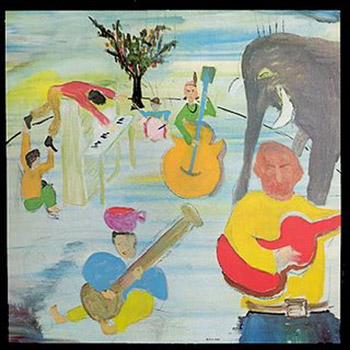
And so on to something marvellous. It's the first three albums by The Band. Now this stuff is, of course, just awesome. First album Music from Big Pink (1968) is a statement of intent, not only using American pastoral and folk traditions to create a whole new kind of rock music, but also setting a template so strong, so robust and so perfect that Americana has taken a long, long time to get beyond it. Interestingly the least successful tunes as far as I'm concerned are the covers of songs by their old mucker Bob Dylan. Robertson's own songs are much clearer in terms of where the band were going to go and how stridently they would go there. Second album, The Band (1969) is a truly remarkable record, expanding and refining all the elements that were so extraordinary on the first album and creating a record that not only has its own mythology but also contributed to creating a mythology of a country in the process. It's an amazing record and a completely coherent and perfectly realised one. Every song is a triumph, from Richard Manuel's astonishingly moving 'Whispering Pines' to Robertson's rocking 'Look Out Cleveland', it's just all gold. From these incredible heights the only way is down and the most remarkable thing about Stage Fright (1970) is how little the quality really drops. There's no denying that the album is more disjointed and the songwriting not as strong as on The Band, but if it had followed directly on from Big Pink, it would have seemed like a natural progression and it only seems lacking in comparison to the brilliance that preceded it. For the first time though there are a couple of songs that don't cut it, and there were albums to come where the ratio goes very wrong, but when an album has 'The Shape I'm In' and 'Stage Fright', there's really nothing to complain about. PS, my editions of those albums have a ton of extra alternate versions and scrapped songs, which although not adding anything to the actual albums are, for once, hugely interesting in their own right. This also explains why there aren't many records today - these each go on for twice the length of the original albums.

The rest of The Band's albums are a mixed bag, varying in quality from the really quite poor (oof, Moondog Matinee) to the great but still patchy (Northern Lights-Southern Cross) so I've always made do with the compilation album To Kingdom Come to cover the best tunes from these albums, and there are some truly fantastic songs ('It Makes No Difference' and 'Acadian Driftwood' being two of the best they ever recorded). To Kingdom Come includes a couple of pre-Big Pink rarities and has tunes from every studio album to 1977 (they split following 1978's live extravangaza The Last Waltz, more of which in a mo), and as such has pretty much all the vital bits of those later albums. The Last Waltz itself is a gargantuan slab of self-congratulation that from a lesser band would seem like the most stomach-churningly vainglorious load of tripe. Imagine inviting some of the biggest stars in rock music to each come and do a brief turn to celebrate your own career - it's truly gruesome egotism, and yet, of course, this being The Band, it's the most spectacular and inviting bit of egotism modern music has ever seen. It's charming even when it's grotesque (I'm looking at you Neil Diamond) and when it's great (I'm looking at you Neil Young) it's fabulous. It doesn't even outstay its welcome at 19.5 hours long. Of course it's always better watching Scorsese's truly groundbreaking concert film of The Last Waltz, but listening to the show is almost as good as watching it.

And with this true greatness the weekend can begin. Nothing of this calibre to come next week, but some charm and some grace and some Bangles, so it's all gravy for a while. Deep breath for Mike "Womble" Batt's musical version of The Hunting of the Snark midweek though - ooooh dear...

Thursday, 16 February 2012

LaRM day 23 (Angelo Badalamenti-Badly Drawn Boy)

Back from holiday (Dublin was very nice thank you) and it's time for some appropriately dark and unnerving soundtrack stuff for being back at work. Angelo Badalamenti's soundtracks to Blue Velvet (1986) and Twin Peaks (1990) are, of course, creepy, unsettling and wonkily old-fashioned. Blue Velvet is in some ways the more creepy of the two, being less obviously stylised. It's more classically arranged and although it does have odd shards of jazz and swing, it's mostly piano pieces framed with nasty found sounds and discordance. Twin Peaks is more specific in its scene-setting, being a twisted amalgamation of 50's dance music, free-form jazz and general spookiness, but it's also somehow a "nicer" listen, smoother, spooky but not jarring. Everybody in the world knows a substantial amount of the soundtrack to Twin Peaks, whether they are aware of it or not, from the title theme to Julee Cruise singing 'Falling'. Both albums are fantastic in their own right, but Twin Peaks works better as a stand-alone album.

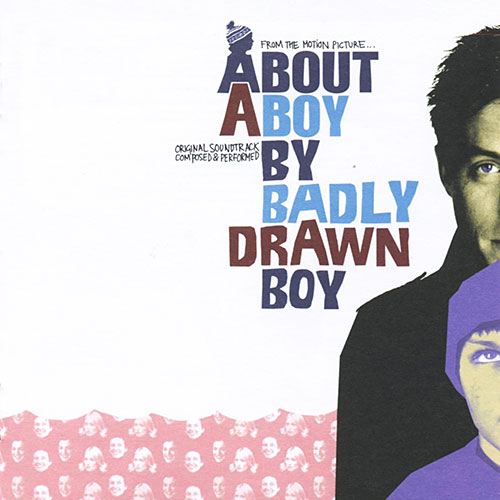
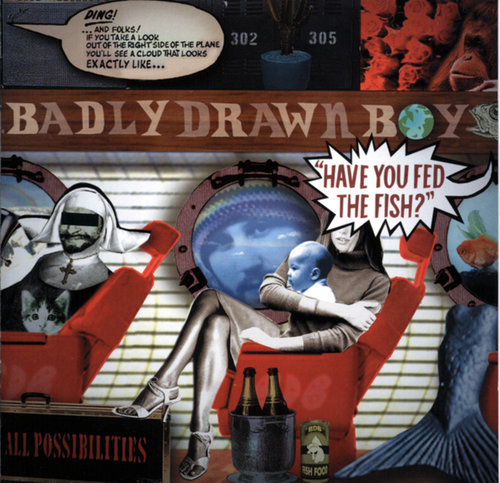
Following which we have something much lighter, it's a Badly Drawn Boy marathon, which starts with debut The Hour of Bewilderbeast (2001). This is an interesting record I think because it sort of sits outside what was happening in indie music at the time. There's a lot more ambition than most people were interested in here, and not in a grandstanding Divine Comedy kind of way, but in a very homely, low-key way. There's a lot going on in these songs and while there are obviously solidly written songs in a "classic" mode, there are plenty of funny noises, and evidence of mucking about which undercuts the surface earnestness of the songs. There are some fine tunes here as well, but while it's the restlessness that makes for the album's finest qualities, it's the restlessness that makes the albums increasingly difficult to listen to. However, second album About a Boy (2002) which was the result of Damon Gough being commissioned to write the soundtrack for the film, manages to stay focussed and concise, and some of the best songs of his career are found here. There's a really warm feeling about his songs at this point, which is what makes some people absolutely adore these records. For my part I could never really find the key to fully getting him. Sometimes the songs are really fabulous and sweet in a cheerfully cosy middle-class kind of way, but too often there's the feeling that ambition and boredom play an equal part in making up Gough's musical inspiration and that really comes through on 2002's Have You Fed the Fish?. It's interesting that such contrasting albums should have come out in the same year, because you get the sense that Have You Fed the Fish was intended to be the "proper" album and About a Boy the filler soundtrack, but it worked out very much the other way around. There's too little cohesion and too smug an atmosphere to HYFtF (If Comet use one of your songs for their ad then you've done something wrong), and it's all too heavily produced. There are still some fine songs but they're drowned by the overall weight of the album and the slick production.

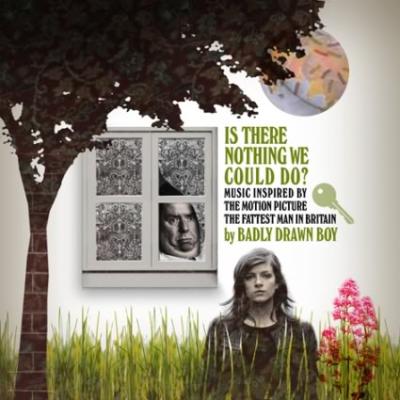
One Plus One is One (2004) is more of the same, but crucially has a stripped back production which allows the songs some room. And there are some excellent songs here. Yet again though, it's the seeming inability to sit still or to let a mood really develop that stymies this album. It's far too long and I end up wishing that he would relax and accept that his best trick is to write lovely, calm, earnest pop songs, with clever arrangements. The apparently restless spirit throws too much into the mix, as ever. When it all works though, it really works beautifully ('Easy Love' for instance) and I can hear just how good a record Have You Fed the Fish could have been with this less showy, easier production. Then it's Born in the UK (2006) which many people think was a bit of a proper return to Hour of Bewilderbeast form, but for me is really a step back towards Have You Fed the Fish and is ultimately all pretty forgettable despite a handful of lovely songs. Finally it's Is There Nothing We Could Do? (2009) which is another soundtrack, this time for Caroline Aherne's TV movie The Fattest Man in Britain. This is more of a traditional soundtrack than About a Boy, mostly made of relatively slight instrumental pieces and a handful of new songs. Interestingly, again, the constrictions imposed as a result of soundtracking someone else's work really seems to bring out the best in Gough, as although it's relatively throwaway, these are some of the nicest and most delicate pieces of music he's written in a long time. There are a couple of more recent albums, but I an't got em.

And so ends yet another day.

Friday, 10 February 2012

LaRM day 22 (Azure Ray-Bachman Turner Overdrive)

And the A journey finally ends with the third album by Azure Ray which is called Hold On Love (2003). This is a great record, a real under the radar number, which didn't really grab anybody's attention which is a shame. It's a successful version of sort of thing that Tegan & Sara try to do with relatively little success, a sort of gloomy spirited but musically engaging femininity. In indie-rock terms, it's a bit more ambitious, a bit smarter, and a bit more dour than most (and certainly than most white-boy indie-rock). It's very muted, it's the aural equivalent of looking through gauze, and it's clearly pretty heartfelt stuff. There are a couple of off moments, but tunes like 'The Drinks We Drank Last Night' and 'These White Lights Will Bend to Make Blue' are so fabulous, they easily make up for any longueurs.

B! At last. Now, as A took a month, I estimate that B should take us seven weeks. Let's see. We kick off with Katy B's On a Mission (2011). I should hate this record. Everything about it is wrong. It's cheap pretend dubstep, sung by a Brits School graduate who looks like Joss Stone. And yet, and yet... what is about this record I wonder? I really, really like it. What can I say, maybe I've just fallen for the hype like every other Guardian reading middle-aged idiot (and as a Guardian reading middle-aged idiot I do find it hard to not fall for certain stuff). If this were marketed differently, or if it wasn't the "dubstep it's easy to like" then maybe I'd hate it, but I don't, I like it a lot. Then again I don't hate pop music on the whole, so maybe it's not so surprising. Anyway, it's alright.

AAARGH, let's shout along to Babes in Toyland and their first album Spanking Machine (1990). I absolutely adored this album back in the day, adored it. It was one the key records that defined my taste at the time, and I really felt that it represented the best of one aspect of the US indie underground. It involves some rather, er, primitive drumming and wholly uninspired bass but the jagged guitar and screaming and shouting of Kat Bjelland really gave it some serious personality. It's claggy, thick stuff and listening to it now feels more difficult than it did back then but it's still an impressive and deeply individual record. In many ways it's a shame that Hole formed after Bjelland kicked Courtney Love out of Babes in Toyland because Hole sounded very similar, but much, much less interesting. 'Fork Down Throat', 'Vomit Heart', 'Dogg', really all the songs are great too. The follow-up mini-album To Mother (1991) is more of the same but is a rather more mixed bag. The better songs are the best they ever recorded ('Catatonic', 'Laugh My Head Off') but the duds are terrible ('Primus', 'Spit to See the Shine') and you can hear that they could take a wrong turn which in my view they did (partly because of the success of grunge affording any bands defined as "grunge" the luxury of higher budgets, which for the most part killed the creativity of the majority of those bands).

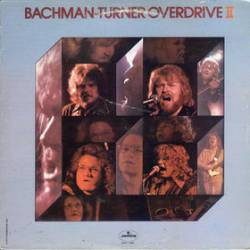
Right, next would be the first six albums by Babybird which came in a box-set for £3. There are a handful of decent tunes buried in this lot, but there's always seemed to me to be something very wrong about Babybird but I've never been able to put my finger on what it is. It all feels sort of nasty, cheap, like the records should smell slightly mouldy or something. Anyway, because I never put them on my ipod the only way to listen to this at work is one song at a time on Youtube and there's no way I'm doing that so we have to skip straight on to the mighty (arise Sir) Bachman Turner OBEverdrive and their second album, the imaginatively titled Bachman Turner Overdrive II (1973). Let there be Canadian 70's rock. We all know 'You Ain't Seen Nothin' Yet' from the first album and of course everything they did is pretty much a variation on that (although II's marimba rock shuffle 'Welcome Home' is a surprise) and if you like to rock in a classic stylee you can never go wrong with the BTO.

That's it for now. I'm on holiday so this mutha will be back up and running next Thursday. Laters!

Thursday, 9 February 2012

LaRM day 21 (David Axelrod-Aztec Camera)

Yikes, let's get all freaked out with 60's uber-producer David Axelrod's own albums. First up it's 1969's Songs of Experience (I haven't got the accompanying Songs of Innocence). Now, I'm not convinced that Blake had funked up basslines and hippy flutes when he was knocking his poetry together, but more fool him if he hadn't because Songs of Experience is awesome. It alternately floats, drifts, bubbles and churns, it's the soundtrack to a kind of pretend version of the 60's that everybody under 40 imagines the 60's were like, which is amazing for a record that was made in the real 60's. It's simultaneously a Beverley Hills fantasy and a ghetto nightmare, it's cheesy, silly and brilliant. 1970's Earth Rot is a slightly more tricky affair - it retains the basic ingredients, but it's all more muted (environmental catastrophe isn't really an upbeat funky bass kind of subject I suppose), and there are some horrible massed voices chanting in a mind-bogglingly cheesily 60's way about what we're doing to the Earth, man. On the whole though Axelrod was still pushing the envelope, throwing in some freeform sax breaks in amongst the downbeat funk and plainsong.

Axelrod's fantastical funk is followed up by the first of our occasional forays into the world of J-Pop with the eponymous debut album by cutesy actress Aya Ueto (2003). J-Pop is, of course, by definition extremely corny and Aya Ueto is at the corniest end of the J-Pop corn spectrum. In fact the cornometer can barely measure this album. It's got some great moments, but it does veer a little close to a Stock Aitken and Waterman style of production on occasion. There are some massive pop songs, that's how this stuff works, but Ueto is no Hikki or Ayu and it's relatively bland stuff compared to those giants of the genre. She's great in the Azumi movies though.

We would then move on to Azita's Enantiadromia (2003) which is a strange post-rockish sort of thing with half of Tortoise playing on it, but it's a vinyl only-no internet job, so we have to move straight on to an Aztec Camera marathon. Now, this may seem a bit strange that I've got a bunhc of Aztec Camera records, but these date from the time when we were getting loads of records at work so I used to pick up all kinds of stuff and that explains quite a lot of what's to come as we travel through the alphabet (five Harry Chapin albums? I mean, really, what was I thinking?). So anyway, High Land Hard Rain (1983) was notoriously written and recorded by Roddy Frame when he was only four years old. Incredible to think that a pre-teen was that adept at jazz chops and formal song structure. He wasn't, he was about seventeen, but there's something vaguely unnerving about a teenager at the turn of the 70's wanting to write jazz inflected pop-rock songs rather then being in a punk band or Bauhaus or something, but there we are. It's a really fine record, uncomfortably competent for a child, but still ragged enough around the edges to be charming, and while the songwriting is mature, the lyrics are still pleasingly naive. Second album Knife (1984) was disastrously produced by Mark Knopfler and the charming edge of High Land, Hard Rain is effectively knocked clean off, leaving simply a "mature" singer-songwriter's album with some horrible keyboards on it which sounds awful and has a serious paucity of decent songs, as Frame seemed to be trying way too hard to write big, serious tunes. It's not actually a totally terrible album ('Still on Fire' is a nice tune) but the R&B influence doesn't sit at all well with Frame's weedy Scottish musical character and it's easy to see why the album got so roundly eviscerated at the time.

After a three year break and the sacking of every other member of the band, Frame came up with the begging letter to the US charts that is Love (1987). This is a seriously insipid piece of half-baked pop music that really doesn't give much cause for hope that he would ever recover the charm of High Land, Hard Rain. It does have chart smash 'Somewhere in My Heart' on it though, and I can't deny that's a great pop song. With the blank indifference of the US clearly smarting, there wasn't another Aztec Camera album for a further three years, and when Stray (1990) was released it was clear that the US breaking ambition had been reined in, and a refocussing really worked wonders. Stray has some great songs, not least the apparently written-in-three-minutes 'Good Morning, Britain'. 'The Crying Scene', 'Notting Hill Blues', there are some great songs here, and all of them back on strictly parochial ground. The rather forced R&B stuff has bitten the bullet and we're back to the much more comfortable jazz-tinged songwriting which works much better.

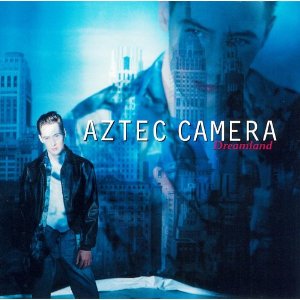
Another three years and another album with 1993's Dreamland. This is almost exactly the kind of record Roddy Frame was always destined to make as he got older. It's polite, graceful, solidly written, nicely produced and entirely inoffensive. It's a delicate record, and one that announces itself in stately fashion with no pretence to anything as radical as innovation or challenge. There's absolutely nothing wrong with it except the fact that it has absolutely nothing of particular interest to say, it's just a perfectly nice early middle-age kind of record. And finally for the Camera, and for the day, it's Frame's last go under the Aztec Camera moniker before accepting that it was almost always a one-man band, Frestonia (1995). This is unsurprisingly more of the same kind of stuff as Dreamland, and I repeat absolutely word for word what I said about that album in relation to this one.

And tomorrow we finally come to the end of the A-road and branch out into the wilder (and considerably lengthier) pastures of the letter B. Let's have a wonderful evening, ready for a whole new alphabetical adventure.

Wednesday, 8 February 2012

LaRM day 20 (At the Drive-In-Avett Brothers)

So, after that little hiatus let's continue with At the Drive-In and their big one, Relationship of Command (2000). This where it all gets more serious and certainly more grandstanding. If anything the absurd angst of the vocals and lyrics combined with a kind of bombastic post-punk arrangement makes me think of a cross between the Manics and U2. Weirdly I really enjoy Relationship of Command but unlike the rest of the world, I think it's basically rubbish. Fun rubbish but rubbish nonetheless. It's like a page from a teenage loner's diary: intense, serious and utterly laughable. After that we've got 2005 compilation This Station is Non-Operational. Most of it is culled from the records we've already gone through but there are a couple of alright tunes from Vaya and some odds and ends, most of which are unnecessary (a dismal prog-punk version of Floyd's 'Take Up Thy Stethoscope and Walk' anybody? No thanks. A shocking cover of 'This Night Has Opened My Eyes'? Hmm, no, I'm alright ta.) and don't add much to what we already know.

Now it's Moo You Bloody Choir (2007) by Augie March. Terrible band name, terrible album name, but they're apparently pretty popular in their native Australia. It's a decent, pleasant and thoughtful rock record. It's fairly instantly forgettable though, so it's one that will be going on the reject pile. That is after all part of the purpose of doing this stupid listening to everything exercise, I've got to get rid of stuff before the floors collapse at home.

But now we get the afternoon started off right with the lovely Au Revoir Simone, starting with debut mini-LP Verses of Comfort, Assurance and Salvation (2005). They're a lovely outfit are Au Revoir Simone. The wheezing and slurring of their vintage keyboards provide a choice backing for the laid-back, emotionally neutral vocals. Their records are restrained affairs in every sense. They're gentle and unchallenging, but there's always the sense of great turmoil underneath the placid exterior, as if not expressing is all about the desperate need to not express. If you see what I mean. Anyway, Verses is the least successful of their three records, only because it's rather uneven in tone, one minute being mournful, the next popping about all over the place (all in politely restrained fashion of course), and on the whole the songs aren't particularly strong. It's still lovely stuff though. The Bird of Music (2007) is the best of the bunch. There are some fabulous pop songs here, and for an album so delicately undemonstrative it always comes as a surprise that some of the songs are weirdly moving. Lyrically there are some peculiar little phrases and any whimsicality is always undercut by a sense of something dark moving underneath the surface. Finally we have Still Night, Still Light (2010) which is, if anything, even more guarded in its approach to a listener and as a result is slightly colder than The Bird of Music and has a greater emphasis on the melancholic end of their style. It's not as immediately enjoyable a listen as a result but it is a fine record nonetheless. (PS I think the description of Au Revoir Simone as being Bananarama with librarians is not quite accurate...).

Let's get all ambient techno on our asses with the first album by Autechre which is called Incunabula (1993). Here's another example of what I was talking about before in relation to the Aphex Twin. I used to pretend I loved this stuff. In fact, listening to Incunabula now I'm struck by how much more I genuinely like it than I did back when I used to pretend to like it. If anything, it's improved with age, and despite still sounding like a 1990's piece of experimental ambient, it has a really nice feel to it, some genuine melodies, and the very low-key way in which it experiments with rhythm and, er, sonic texture means that it doesn't sound so obviously of its time in the way that much of this stuff does. In many ways it's to do with the very clinical and spacious feel of the record, there's no concession to clubbers really, it's pretty much all just bedroom headphone atmospherics, and it still works really well.

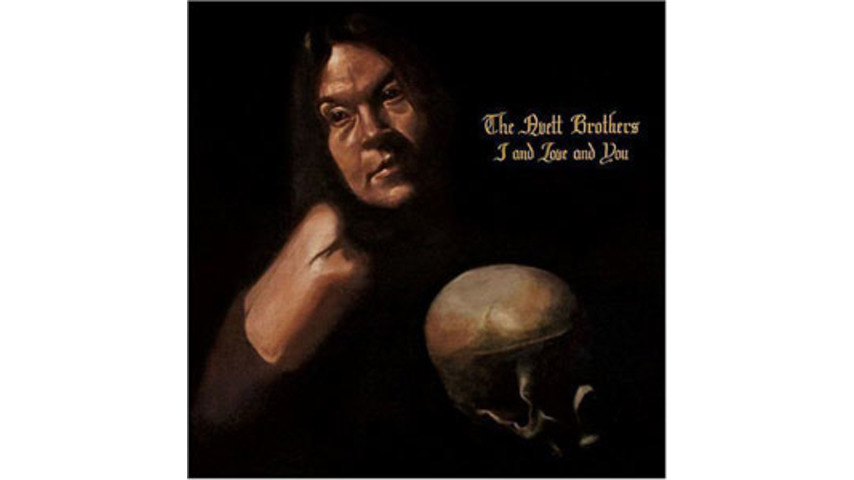
And finally for today it's another one that's going on the reject pile, I And Love And You (2009) by the Avett Brothers. This is another one of those folksy, Americana-y, way too serious-y records which you only half concentrate on and think sounds really good, rootsy, good tunes, but when you give it your full attention you realise is really only half a record. One of those v. good, but could try harder type of efforts. When space in your tiny flat is at a premium, it's cheerio to the Avett Brothers.

We might finish A tomorrow. How about that then boys and girls?